


Is Native American Jewelry a Good Investment?
Table of Contents
- Why Native American Jewelry Attracts Serious Collectors
- Factors Affecting Turquoise Jewelry Value
- How to Identify Authentic Navajo Jewelry
- Best Heirloom Quality Turquoise Jewelry Brands and Makers
- Ethical Consumption vs. Financial Speculation in Native American Jewelry
- Tax, Insurance, and Asset Protection for High-Value Collections
- Market Trends Shaping Collectible Value in 2026
- Building a Collection Worth Passing Down
Last Updated: August 23, 2026
Why Native American Jewelry Attracts Serious Collectors
Native American jewelry represents a convergence of cultural heritage, material rarity, and individual artistry. At Turquoise Mustang, we work directly with Navajo and Zuni artisans, and we've watched collectors recognize that authentic pieces hold meaning and market value in ways mass-produced jewelry cannot replicate.
Authentic squash blossom necklaces, wide-cuff bracelets set with natural turquoise, and hand-stamped silverwork represent a living craft tradition with a finite number of practitioners. When a master silversmith retires, their body of work becomes a closed set. That scarcity is structural, not manufactured.
Serious collectors research provenance, understand the difference between natural and stabilized turquoise, and buy from artisans with documented tribal affiliation. The Indian Arts and Crafts Board at the U.S. Department of the Interior has documented the cultural and economic significance of this craft tradition, providing a framework that collectors can use to ground their acquisitions in verified authenticity.
Below, we'll walk through every factor that affects value, how to authenticate what you're buying, what the market looks like heading into 2026, and how to protect a collection worth protecting.
Factors Affecting Turquoise Jewelry Value
Valuing native american jewelry requires examining several interconnected variables simultaneously.
| Factor | What to Examine | Impact on Value |
|---|---|---|
| Stone quality | Natural vs. stabilized vs. synthetic | High |
| Silver gauge | Weight and thickness of sterling | Medium-High |
| Hallmark / signature | Verified artist mark | High |
| Artist tier | Emerging vs. established vs. master | Very High |
| Provenance | Purchase history, documentation | Medium-High |
| Age / patina | Vintage vs. contemporary | Medium |
| Tribal affiliation | Documented Navajo, Zuni, etc. | High |
Stone Quality: Natural vs. Stabilized Turquoise
Natural turquoise comes directly from the mine with no chemical treatment. Its color, matrix pattern, and hardness reflect specific geology. Mines like Sleeping Beauty, Bisbee, and Royston each produce stones with recognizable characteristics that experts can identify.
Stabilized turquoise has been impregnated with resin to harden softer material and deepen color. It's widely used but commands lower prices than natural material. The critical issue is disclosure: a reputable seller always specifies which type you're buying.
Synthetic turquoise and dyed howlite have negligible collectible value. Investment-grade collections avoid them entirely. Stone quality assessment covers color saturation, matrix character, surface hardness, and mine provenance.
Silver Gauge, Hallmarks, and Silversmithing Technique
Sterling silver is standardized at 92.5% purity, but gauge and technique vary enormously between artisans. Heavy-gauge cuffs with deep hand-stampwork, repoussé, and twist wire framing represent significantly more labor and skill than thin-gauge pieces.
A hallmark is the artist's personal stamp, usually initials or a unique symbol, pressed into the silver. Hallmarks function as signatures, connecting the piece to a specific maker and enabling authentication and provenance tracking. Pieces without hallmarks are harder to attribute and carry lower market values.
Tufa casting, which involves carving a design into volcanic tufa stone and pouring molten silver into the mold, produces distinctive, unreproducible texture. Sawtooth bezels, the small serrated metal lips holding stones, are another marker of hand craftsmanship that distinguishes authentic work from factory production.
Artist Tiering: How the Maker Determines Market Value
The native american jewelry market operates on an informal but real tiering system. Emerging artisans produce competent work at accessible price points. Mid-tier makers have established reputations, documented exhibition records, and recognizable stylistic signatures. Master silversmiths, whose work appears in museum collections and major auction catalogs, command multiples bearing no relationship to material cost alone.
Buying from a documented, named artisan with tribal affiliation is the single most important investment decision you can make in this category. The piece becomes part of that artist's catalog. As their reputation grows, so does the value of every signed piece they've produced.
How to Identify Authentic Navajo Jewelry
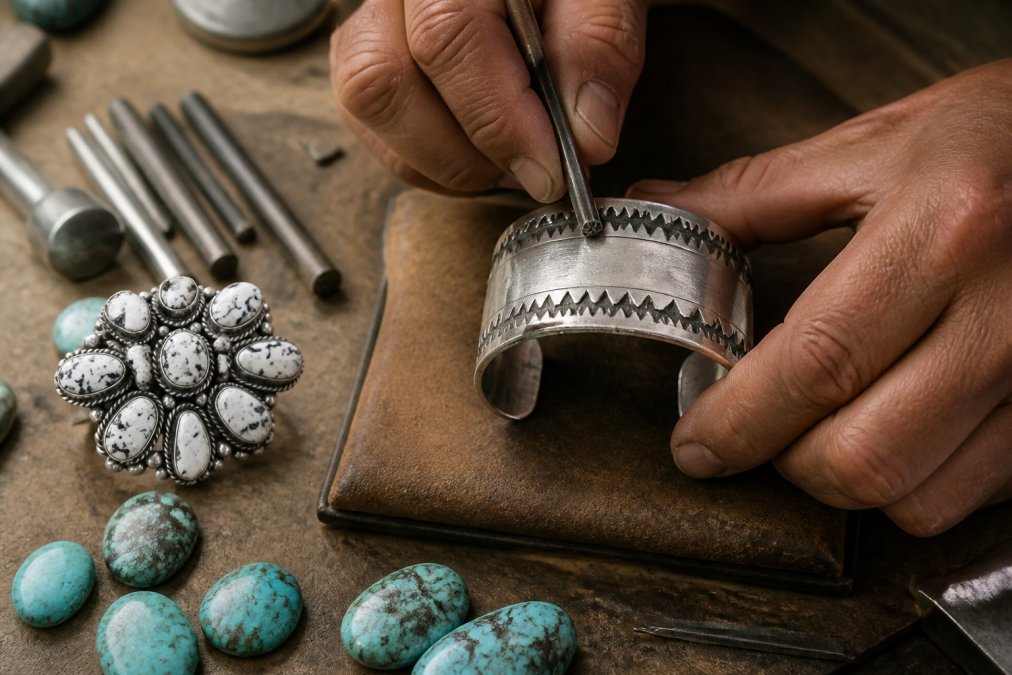
Authentic Navajo jewelry is silverwork created by a Navajo artisan using traditional techniques, with verifiable tribal affiliation and ideally a personal hallmark. Authentication involves examining the piece itself, the documentation behind it, and the seller's sourcing practices.
What the Indian Arts and Crafts Act Requires
The Indian Arts and Crafts Act of 1990 prohibits misrepresenting a product as "Indian-made" when it is not produced by a member of a federally recognized tribe. Violations carry significant civil and criminal penalties.
Any seller marketing jewelry as "Navajo-made" or "Zuni-made" is legally required to ensure that claim is accurate. Ask sellers directly for documentation of tribal affiliation. A reputable source will have it. A source that deflects the question is one to avoid.
The law does not regulate quality, technique, or material authenticity. Those assessments remain the buyer's responsibility.
Reading Hallmarks, Provenance, and Tribal Affiliation
Hallmark identification is a learnable skill. Most established Navajo and Zuni silversmiths register their marks, and reference materials exist to cross-check them. Look for the hallmark on the interior of a cuff, the back of a pendant, or the shank of a ring.
Provenance documentation strengthens any piece's value. Ideally, this includes the original purchase receipt, the artisan's name and tribal enrollment information, and any exhibition or publication history. For vintage pieces, auction house records or gallery documentation serve the same function.
Tribal affiliation connects the work to a specific tradition of silversmithing. Navajo silversmithing and Zuni lapidary work are distinct traditions with different technical signatures. Knowing which tradition produced a piece helps authenticate it and positions it correctly within the collector market.
Best Heirloom Quality Turquoise Jewelry Brands and Makers
The strongest collections are built around named artisans, not anonymous production. Turquoise Mustang sources directly from documented Navajo silversmiths.
Jimmie Yazzie's White Buffalo Nine-Stone Cluster Cuff arranges nine high-domed White Buffalo stones in a floral cluster pattern on an extra-wide sterling silver cuff with deep stampwork, scalloped edges, repoussé, and twist wire framing. This piece demonstrates the multi-technique execution that defines investment-grade work.

Chris Yazzie's Mixed Turquoise 23-Stone Extra-Wide Cluster Cuff sets 23 natural turquoise stones spanning multiple mines across an extra-wide sterling cuff in sawtooth bezels with traditional stampwork. The multi-mine composition becomes more interesting to collectors as specific mines close or reduce production.

Stewart Billie's Multi-Stone Inlay Ring with Tufa Cast Shank illustrates how technique diversity within a single piece adds collectible depth. The rectangular mosaic inlay combines turquoise, mother of pearl, lapis, and natural stone on a tufa cast shank.

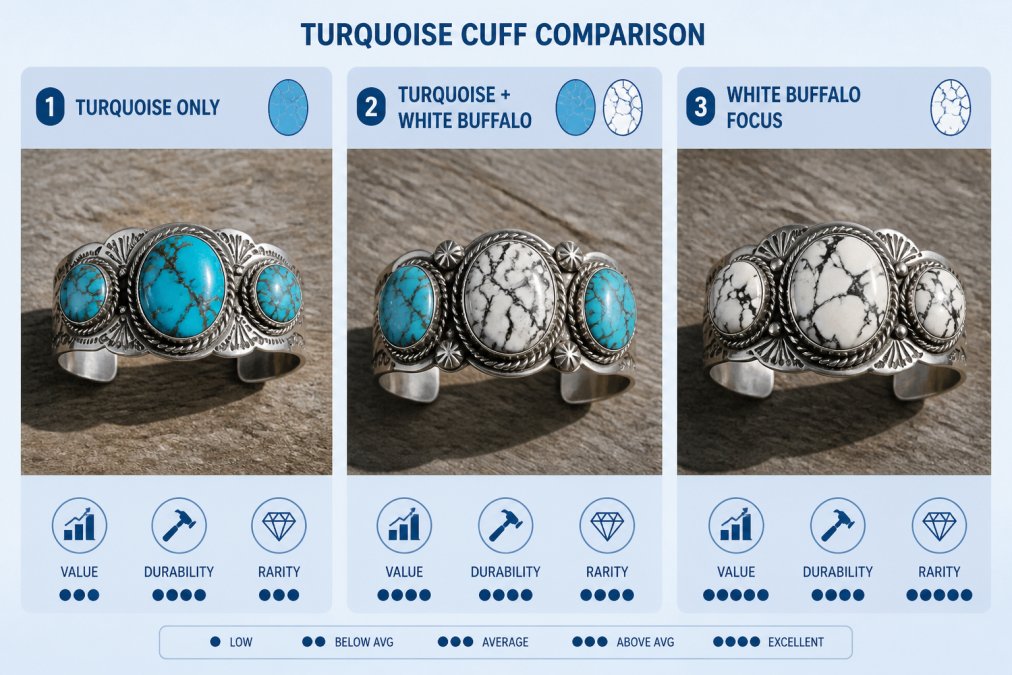
Turquoise Mustang also offers proprietary Western jewelry lines: all sterling silver, made with a variety of authentic stones and clearly hallmarked to distinguish our products from Native made jewelry.
When evaluating any maker for heirloom purposes, prioritize documented tribal affiliation, a consistent personal hallmark, and a body of work spanning multiple years.
Ethical Consumption vs. Financial Speculation in Native American Jewelry
Buying native american jewelry purely as a financial asset, without regard for cultural context, differs from collecting with genuine appreciation for the craft tradition. Speculative buying that drives prices beyond what working artisans benefit from can distort the market in ways that harm producing communities.
Collectors who engage seriously with the tradition, learning artisans' names, understanding techniques, and buying through channels that compensate makers fairly, contribute to the ecosystem rather than extracting from it. Collectors who understand the cultural heritage behind what they own tend to make better authentication decisions, build stronger relationships with reputable sources, and hold pieces long enough to realize their full appreciation potential.
As the Smithsonian National Museum of the American Indian has documented, the economic health of Native artisan communities is directly tied to the integrity of the market for their work.
Tax, Insurance, and Asset Protection for High-Value Collections
A collection including pieces valued in the thousands requires the same asset protection thinking you'd apply to any significant personal property.
Insurance: Standard homeowners or renters policies typically apply sublimits to jewelry and collectibles that fall well below actual collection value. A scheduled personal property endorsement or standalone fine art and collectibles policy covers individual pieces at their appraised value. Get a professional appraisal before purchasing coverage.
Appraisals: A qualified appraiser with specific expertise in Native American jewelry is essential. Valuation of a signed Navajo cuff depends on artist reputation, tribal affiliation documentation, and current collector market factors. The American Society of Jewelry Appraisers maintains a directory of credentialed appraisers with specialized expertise.
Tax considerations: Collectibles held for more than one year and sold at a profit are subject to capital gains tax. The IRS treats collectibles as a distinct asset class with a maximum long-term capital gains rate higher than that applied to stocks and bonds. Consult a tax professional familiar with collectible assets before selling significant pieces.
Documentation: Maintain a written inventory with photographs, purchase receipts, appraisal records, and provenance documentation for every piece. Store copies offsite or in cloud backup.
Market Trends Shaping Collectible Value in 2026
The market for authentic Native American jewelry has been strengthening heading into 2026. Collector interest in wearable cultural heritage has grown alongside broader trends toward craft authenticity and provenance-conscious consumption.
Mine closures and stone scarcity. Several historically significant turquoise mines have reduced output or closed entirely. Pieces featuring verified natural stones from these mines carry increasing rarity premiums. The Bisbee mine in Arizona produced a distinctive deep blue-green turquoise with characteristic brown matrix that is now extremely limited in supply.
Authentication technology. Spectroscopic analysis and other non-destructive testing methods are becoming more accessible, making it easier to distinguish natural from stabilized turquoise and verify silver purity. Collectors who invest in authentication documentation now will have stronger resale positions as these standards become more widespread.
Generational wealth transfer. As established collectors age, significant pieces are entering the secondary market through estate sales and auctions, creating acquisition opportunities for informed buyers while introducing more pieces without complete provenance chains into circulation.
Digital marketplace expansion. Online platforms have broadened geographic reach, connecting collectors with artisans and reputable dealers across the country. This increased liquidity generally supports price appreciation for documented, authenticated pieces.
Building a Collection Worth Passing Down
The difference between a collection and an accumulation comes down to intention and documentation.
A collection built for generational legacy starts with a clear acquisition philosophy: named artisans, verified tribal affiliation, natural or clearly disclosed stabilized materials, and documented provenance from the point of purchase. Every piece should be accompanied by a record of who made it, when you acquired it, what you paid, and what authentication documentation exists.
Heirloom quality is not purely about price point. A well-documented piece by a mid-tier maker with complete provenance can be a stronger heirloom than an expensive piece with no paper trail.
Care and preservation matter too. Sterling silver develops patina over time, which many collectors value as evidence of age and authenticity. Store pieces individually in anti-tarnish cloth, avoid harsh chemicals, and have significant pieces professionally cleaned and inspected periodically. Turquoise is relatively soft and porous; never clean it with ultrasonic equipment or steam.
The real legacy of a well-built native american jewelry collection is not just financial. It's a documented record of specific artisans, specific craft traditions, and specific moments in the living history of Navajo and Zuni silversmithing.
Building a serious collection of native american jewelry requires authentication knowledge, provenance discipline, and asset protection thinking that most lifestyle guides never address. Turquoise Mustang sources directly from named Navajo and Zuni artisans, provides full documentation of tribal affiliation, and offers pieces that meet investment-grade standards for hallmarking, stone quality, and silversmithing technique. Browse our collection to find pieces built to be passed down.
Frequently Asked Questions
Does Native American jewelry increase in value over time?
Authenticated pieces by recognized Navajo and Zuni artisans have historically appreciated, particularly squash blossom necklaces, wide cluster cuffs, and hand-stamped silverwork set with natural, untreated turquoise. Appreciation is not guaranteed, but investment-grade pieces with documented provenance, clear hallmarks, and verifiable tribal affiliation tend to hold or grow their resale value as collector demand outpaces supply of genuinely hand-crafted work.
How can you tell if Native American jewelry is authentic?
Start with the hallmark: authentic pieces are typically stamped with the artist's initials, name, or tribal affiliation, along with a sterling silver mark. Under the Indian Arts and Crafts Act of 1990, it is illegal to misrepresent jewelry as Native-made when it is not. Look for hand-stamping irregularities, sawtooth bezels set by hand, and natural stone matrix patterns. Ask the seller for the artist's name, tribal affiliation, and any appraisal or provenance documentation.
What type of jewelry holds the best investment value?
Pieces combining natural (non-stabilized) turquoise, heavy-gauge sterling silver, and documented artisan provenance consistently outperform mass-produced alternatives at resale. Squash blossom necklaces, extra-wide cluster cuffs, and tufa cast pieces by named Navajo or Zuni silversmiths are among the most collectible categories. Condition, completeness of hallmarking, and the artist's standing within the collector community all influence long-term market value.
Who buys Native American jewelry, and where is the resale market?
The primary buyers are established collectors, estate auction houses, gallery curators, and discerning gift-buyers seeking culturally significant heirlooms. Secondary markets include specialized auction platforms, tribal arts dealers, and antique shows focused on Southwestern art. Pieces by well-known Navajo and Zuni artisans attract competitive bidding. Provenance documentation and original appraisals significantly improve both the speed and price of resale.
This article was written using GrandRanker