


Best Places to Buy Authentic Turquoise Jewelry
Table of Contents
- What Makes Authentic Turquoise Worth Seeking Out
- Stabilized vs Natural Turquoise: What Every Buyer Should Know
- How to Identify Real Turquoise Jewelry Before You Buy
- Native American Turquoise Jewelry Hallmarks Explained
- The Best Places to Buy Authentic Turquoise Jewelry
- Turquoise Grading, Mine Origins, and Price-per-Carat Value
- Caring for Your Turquoise and Sterling Silver Pieces
- Conclusion
Last Updated: August 21, 2026
Finding authentic turquoise in a market flooded with imitations, dyed howlite, and mass-produced knockoffs is harder than it should be. At Turquoise Mustang, we work directly with Navajo and Zuni silversmiths whose names appear on every piece. This guide cuts through the confusion by covering what separates genuine turquoise from its many impostors, where to buy authentic pieces, and how to verify quality before you spend a dollar.
A piece of handcrafted Native American turquoise jewelry is not just a purchase, it's a cultural artifact, a lapidary achievement, and a long-term investment.
What Makes Authentic Turquoise Worth Seeking Out
Genuine turquoise is a hydrous phosphate mineral that forms in arid regions where copper-rich groundwater interacts with aluminum-bearing rock over thousands of years. No two stones are identical. The American Southwest produces some of the world's most historically significant turquoise. Kingman turquoise from Arizona is known for its bright sky-blue color and characteristic black matrix. Royston turquoise from Nevada displays deep blue-green against warm brown host rock. Dry Creek turquoise is prized for its rare chalky white to pale blue color with little to no matrix.

The stone alone doesn't determine value, the silversmithing matters equally. A natural turquoise cabochon set in heavy sterling silver with hand-stamped geometric patterning by a named Navajo artisan is worth considerably more than the same stone in a machine-finished mounting. According to the Smithsonian Institution's overview of Native American jewelry traditions, turquoise has been central to Southwestern Indigenous cultures for over a thousand years.
Stabilized vs Natural Turquoise: What Every Buyer Should Know
Natural Turquoise
Natural turquoise is stone extracted from the mine, cut, and polished without chemical treatment or enhancement. It retains its original hardness, color, and matrix exactly as formed. Stones rated 5 to 6 on the Mohs hardness scale are considered gem-grade. Always ask sellers to confirm the stone has not been stabilized, treated, or coated.
Stabilized Turquoise
Stabilized turquoise is genuine turquoise impregnated with clear resin or epoxy under pressure to harden softer, porous material. The process doesn't change color, only improves durability. Stabilized turquoise is widely used in legitimate Native American jewelry and is not deceptive if disclosed. It's more affordable and durable in everyday wear than natural turquoise at the same quality grade.
Treated and Imitation Turquoise
Treated turquoise includes stones dyed to enhance or change color, often howlite or magnesite dyed to mimic turquoise. Imitation turquoise includes plastic, glass, and reconstituted material (powdered turquoise compressed with binding agent and dyed).
Per the Federal Trade Commission's jewelry guides on disclosure requirements, sellers are legally required to disclose treatments that affect a gemstone's value. Reconstituted "turquoise" can look convincing in photographs, but in person, real turquoise shows subtle color variation and matrix irregularity that reconstituted material cannot replicate.
How to Identify Real Turquoise Jewelry Before You Buy
Visual and Physical Tests
- Color variation: Natural and stabilized turquoise shows subtle shifts in hue. Dyed imitations tend toward uniform, flat color.
- Matrix pattern: Genuine matrix is irregular and three-dimensional. Printed or painted matrix on imitation stones looks flat and repeats.
- Surface temperature: Real turquoise feels cool to the touch. Plastic imitations warm quickly.
- Weight: Genuine stone and sterling silver together produce noticeable heft. Lightweight pieces are a warning sign.
- Hallmark: Authentic Native American silverwork is hallmarked with the artisan's initials or stamp, a sterling mark, and sometimes a tribal affiliation mark on the reverse.
Online Buyer Verification Checklist
- Is the artisan named by full name, tribal affiliation, and technique?
- Does the listing specify natural, stabilized, or treated turquoise?
- Is the silver described as sterling (92.5% silver) or coin silver, not "silver-tone" or "silver-plated"?
- Are hallmark photos included showing the reverse of the piece?
- Does the seller have a verifiable return policy and authentication documentation?
- Is the mine origin of the turquoise identified (e.g., Kingman, Royston, Carico Lake)?
- Are multiple high-resolution photos available, including close-ups of the stone's surface?
- Does the price reflect the quality claimed? Suspiciously low prices for "natural" stones are a red flag.
Native American Turquoise Jewelry Hallmarks Explained
A hallmark is the single most reliable authentication tool for Native American turquoise jewelry. Every piece of genuine artisan-made silverwork carries the maker's mark.

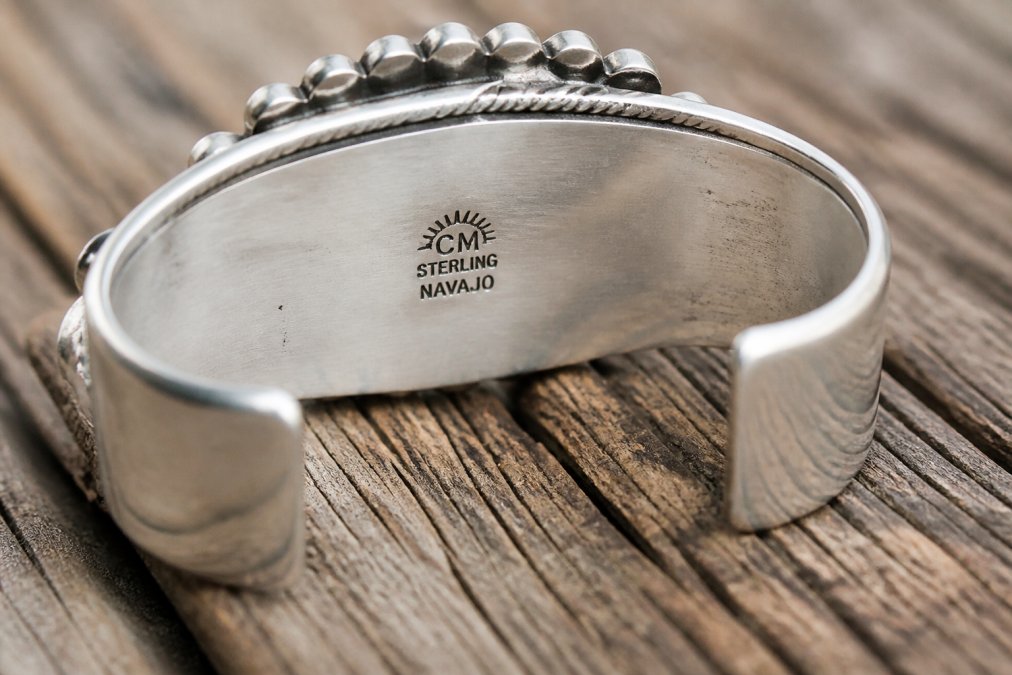
Navajo and Zuni silversmiths register personal stamps, typically initials, a symbol, or a combination, that identify their work. These stamps are pressed into the silver on the reverse of the piece. A genuine piece shows the artisan's mark alongside a sterling designation ("STERLING" or "925"). Some pieces also carry a tribal hallmark from the Navajo Nation or Pueblo of Zuni.
The Indian Arts and Crafts Act of 1990, enforced by the Indian Arts and Crafts Board at the U.S. Department of the Interior, makes it illegal to misrepresent non-Native-made goods as Native American handmade. What to look for on a hallmarked piece:
- Artisan initials or symbol: Pressed directly into the silver, not engraved after the fact
- Sterling mark: "STERLING" or "925" confirming 92.5% silver content
- Tribal designation: Present on some pieces, not universal
- Consistency: The hallmark should show the same patina and oxidation as the rest of the piece
At Turquoise Mustang, every Native American piece is attributed to the specific artisan by name and tribal affiliation, with hallmark documentation available for each item.
The Best Places to Buy Authentic Turquoise Jewelry
| Source | Best For | Key Advantage | Main Risk |
|---|---|---|---|
| Curated online retailers | Collectors, gift buyers | Artisan attribution, wide selection | Cannot inspect in person |
| Tribal arts galleries | Serious collectors | Direct cultural context | Limited inventory, geographic access |
| Wholesale/retail with artisan attribution | Boutique buyers | Volume access, verified sourcing | Requires due diligence on sourcing claims |
| Juried craft shows | Buyers wanting direct artist contact | Meet the maker, immediate authentication | Seasonal, geographically limited |
| Proprietary Western jewelry lines | Style-focused buyers | Consistent hallmarking, sterling verified | Different tradition than Native-made |
1. Curated Online Retailers Specializing in Native American Jewelry
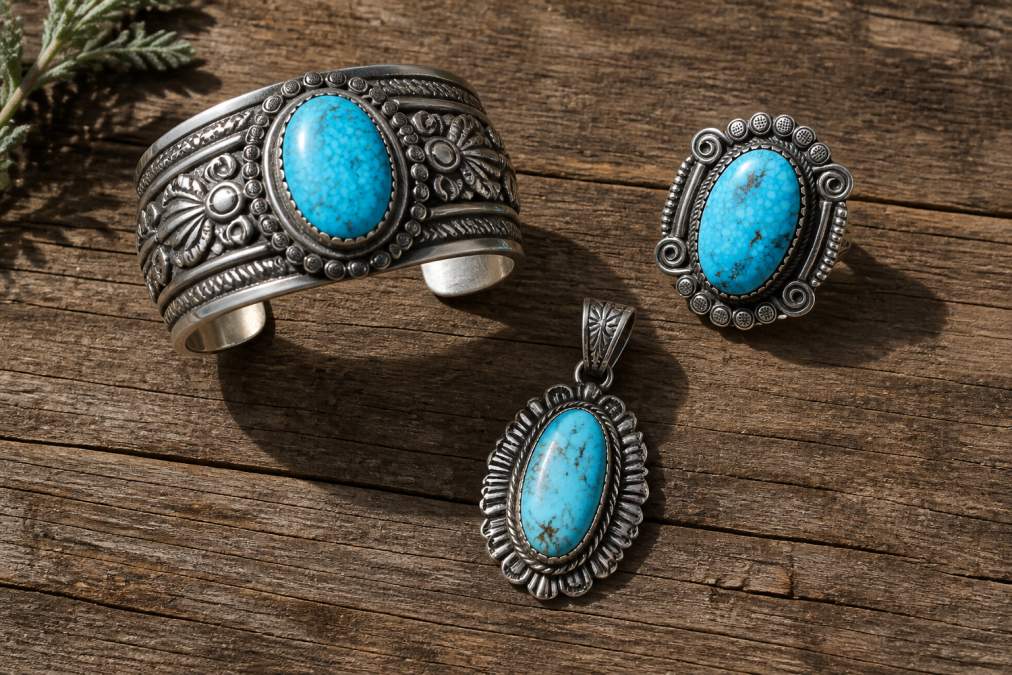
The best places to buy authentic turquoise online name the maker. Not "Navajo-style" or "Southwestern-inspired," but the actual artisan, their tribal affiliation, and their technique. Turquoise Mustang is built on this model. Every piece is attributed to its maker. The Birdseye Kingman Turquoise Ring was made by Calvin Martinez, a Navajo silversmith known for bold and precise stampwork, who set a large oval birdseye Kingman cabochon in heavy sterling silver with deeply impressed geometric patterns. The Carico Lake Turquoise Mosaic Inlay Ring by Navajo silversmith Rita Dawes features one of the rarest turquoise varieties: Carico Lake turquoise, immediately recognizable by its vivid apple-green color.
When evaluating any online retailer, the artisan attribution test is non-negotiable. If a site cannot tell you who made the piece, treat it as unverified.
2. Tribal Arts Galleries and Museum Shops
Tribal arts galleries and museum shops associated with institutions like the Heard Museum or the Wheelwright Museum of the American Indian offer certified, juried work with provenance documentation. The limitation is practical: inventory is curated to a narrow selection, and the best pieces move quickly.
3. Established Wholesale and Retail Sources with Artisan Attribution
Boutique owners sourcing for retail should prioritize wholesale partners who maintain artisan attribution through the supply chain. Turquoise Mustang offers wholesale access to our collection, including the Red Web Kingman Turquoise Stampwork Cuff by Delbert Gordon, a master Navajo silversmith whose signature curled rope overlay technique is immediately recognizable to collectors, and the Waterweb Kingman Turquoise Seven-Row Cuff by Roland Dixson, featuring natural Kingman turquoise with vivid waterweb matrix.

4. Juried Craft Shows and Native American Art Markets
Markets like the Santa Fe Indian Market and the Heard Museum Guild Indian Fair & Market are among the most reliable venues for buying authentic turquoise jewelry directly from the artisan. Work shown at juried markets has been vetted by expert panels, and the maker is physically present, eliminating authentication uncertainty.
5. Proprietary Western Jewelry Lines with Certified Sterling
For collectors drawn to Southwestern aesthetics who want verified quality without the cultural specificity of tribal attribution, proprietary Western jewelry lines offer a distinct category. We also offer our own proprietary lines of Western jewelry. These are all sterling, made with a variety of authentic stones and clearly hallmarked to distinguish our products from Native made jewelry.
Turquoise Grading, Mine Origins, and Value
Turquoise grading is not standardized like diamond grading. The market grades turquoise across four factors: hardness, color, matrix, and mine origin.
Hardness is the most fundamental quality indicator. Gem-grade natural turquoise rates 5 to 6 on the Mohs scale. Color preference varies by collector, but vivid, saturated blues and blue-greens command the strongest premiums. Matrix adds or subtracts value depending on its character. Fine, symmetrical spiderweb matrix, like the Black Spiderweb Kingman in Andy Cadman's repoussé cuff, commands serious collector premiums.
Mine origin is increasingly significant as historic American turquoise mines produce less material. Carico Lake, Dry Creek, Royston, and high-grade Kingman varieties carry name recognition among collectors that translates directly to price. Per the Gemological Institute of America's overview of turquoise as a gemstone, mine-specific identification adds meaningful provenance value to natural turquoise. The silversmithing adds a separate layer of value, a master artisan's labor, technique, and reputation are priced into the finished piece independently of the stone.
Caring for Your Turquoise and Sterling Silver Pieces
Turquoise is relatively soft and porous, requiring more careful maintenance than harder gemstones. Its porosity makes it reactive to chemicals, moisture, and heat.
For the turquoise:
- Keep turquoise away from perfumes, lotions, and cleaning products. The stone absorbs chemicals that can permanently alter its color.
- Avoid prolonged direct sunlight, which can cause fading in some varieties.
- Store pieces individually in soft pouches to prevent surface scratching.
- Never use ultrasonic cleaners on turquoise.
For the sterling silver:
- Sterling silver oxidizes naturally over time, developing a patina many collectors prefer. Use a soft polishing cloth designed for silver if you want to maintain bright silver.
- Avoid silver dips and chemical polishes on pieces where oxidized stampwork is intentional, the dark oxidation in the recesses of Navajo stampwork is part of the design.
- Store silver pieces in anti-tarnish pouches or with silica gel packets to slow oxidation.
With heirloom-quality pieces, avoid over-cleaning. The patina on a well-made Navajo cuff tells a story.
Collecting authentic turquoise jewelry rewards patience and knowledge. The market is full of imitations that photograph well and disappoint in person. Turquoise Mustang was built to close that gap, with named artisans, hallmarked sterling silver, verified mine-origin stones, and a proprietary Western line clearly distinguished from our Native American collection. Browse our collection of handcrafted Navajo and Zuni pieces, or reach out to discuss wholesale opportunities for your boutique.
Frequently Asked Questions
How can you tell if turquoise jewelry is real or fake?
Genuine turquoise feels cool and slightly waxy to the touch, shows natural color variation across the stone, and has matrix patterns that run through the stone rather than sitting on the surface. Imitation materials like dyed howlite or plastic often have uniform color, no depth in the matrix, and feel lighter. For Native American pieces, look for a hallmark, artisan name, and sterling silver stamp, these are strong indicators of authentic turquoise set by a real silversmith.
Is stabilized turquoise considered authentic?
Stabilized turquoise is genuine turquoise, it starts as real mined stone. The stabilization process infuses a clear resin into porous or soft material to harden it for use in jewelry. It is widely accepted in the trade and legal to sell as turquoise when properly disclosed. Natural, untreated turquoise commands higher prices because it requires no enhancement, but stabilized stone is not fake. The problem arises when sellers pass off stabilized material as natural without disclosure.
What are the signs of authentic Native American turquoise jewelry?
Authentic pieces carry a hallmark stamped into the silver, typically the artisan's initials or symbol alongside a sterling mark. The Indian Arts and Crafts Act of 1990 makes it a federal offense to misrepresent jewelry as Native American-made when it is not. Beyond legal protection, look for hand-cut cabochons with slight irregularities, hand-stamped silver with consistent but not machine-perfect patterns, and a seller who can name the specific artisan and their tribal affiliation.
Why is authentic turquoise so expensive?
Several factors drive the price of genuine turquoise. The most collectible American mines, Kingman, Royston, Carico Lake, and Dry Creek, produce limited quantities, and some have reduced or ceased production. Natural, untreated stones in high-grade colors command a premium over stabilized material. Add the labor of skilled Navajo or Zuni silversmiths who hand-cut each cabochon, hand-stamp the silver, and spend hours on a single piece, and the price reflects genuine scarcity and artisan skill rather than marketing.
How do I verify the authenticity of a turquoise hallmark?
A legitimate hallmark on Native American jewelry includes the artisan's personal stamp or initials and a sterling silver mark. Reputable sellers provide written documentation naming the artisan, their tribal nation, and the stone's mine origin when known. The Indian Arts and Crafts Board, a federal agency under the U.S. Department of the Interior, maintains resources on authentic Native American art and can assist buyers who suspect misrepresentation. When buying online, request close-up photos of the hallmark before purchasing.
This article was written using GrandRanker