


How to Identify Authentic Navajo Jewelry
Table of Contents
- What Makes Authentic Navajo Jewelry Different
- Native American Jewelry Hallmark Identification
- How to Spot Fake Native American Jewelry
- Indian Arts and Crafts Act Compliance: What Buyers Must Know
- Turquoise Quality and Stone Setting in Authentic Navajo Jewelry
- Step-by-Step Authentication Checklist Before You Buy
- Provenance, Documentation, and Buying From Reputable Sources
- Conclusion
Last Updated: August 20, 2026
Knowing how to identify authentic Navajo jewelry separates a meaningful heirloom from an expensive mistake. At Turquoise Mustang, we work directly with Navajo and Zuni artisans, and we see buyer confusion: pieces marketed with Southwestern imagery that have no connection to any Native American maker. The market for authentic Navajo jewelry is real, the counterfeits are convincing, and the legal protections are stronger than most buyers realize. Below, we'll walk through the exact material, hallmark, and legal indicators that distinguish genuine bench-made work from mass-produced imitations.
What Makes Authentic Navajo Jewelry Different
Authentic Navajo jewelry is distinguished by hand-fabricated construction, sterling silver composition, and the direct involvement of a Navajo artisan in every stage of production.
Sterling Silver vs. Nickel Silver and Base Metal
Authentic Navajo pieces are made from sterling silver, a 92.5% silver alloy. Nickel silver contains no silver at all, it is a copper-zinc-nickel alloy that mimics silver's appearance at a fraction of the cost.
Genuine sterling silver carries a "925," "Sterling," or "Ster" mark somewhere on the piece, usually on the interior of a cuff or the back of a pendant. The absence of any silver purity mark is a serious red flag. Nickel silver tends to feel lighter for its size and develops a yellowish or greenish tarnish rather than the warm grey oxidation of aged sterling. Sterling silver also has a specific density that gives authentic Navajo cuffs and squash blossom necklaces a satisfying heft. A piece that feels hollow or unusually light relative to its size warrants scrutiny.
Handmade Techniques: Stamp Work, Repoussé, and Sand Casting
Three techniques appear most consistently in genuine Navajo work:
- Stamp work: A silversmith uses hand-cut steel stamps to press repeating geometric patterns into the silver surface. Each impression is slightly irregular, reflecting the human hand.
- Repoussé: The silversmith works silver from the reverse side, pushing metal outward to create raised, three-dimensional designs. Machine-made pieces simulate this with molded casting, but lack the subtle variation of hand-worked metal.
- Sand casting and tufa casting: Molten silver is poured into carved sand or tufa stone molds. The texture is unique to each pour, and no two pieces are identical.
Slight asymmetries in stamp work, minor tool marks on the reverse, and variation in bezel height are evidence of hand craftsmanship, not defects.
Native American Jewelry Hallmark Identification
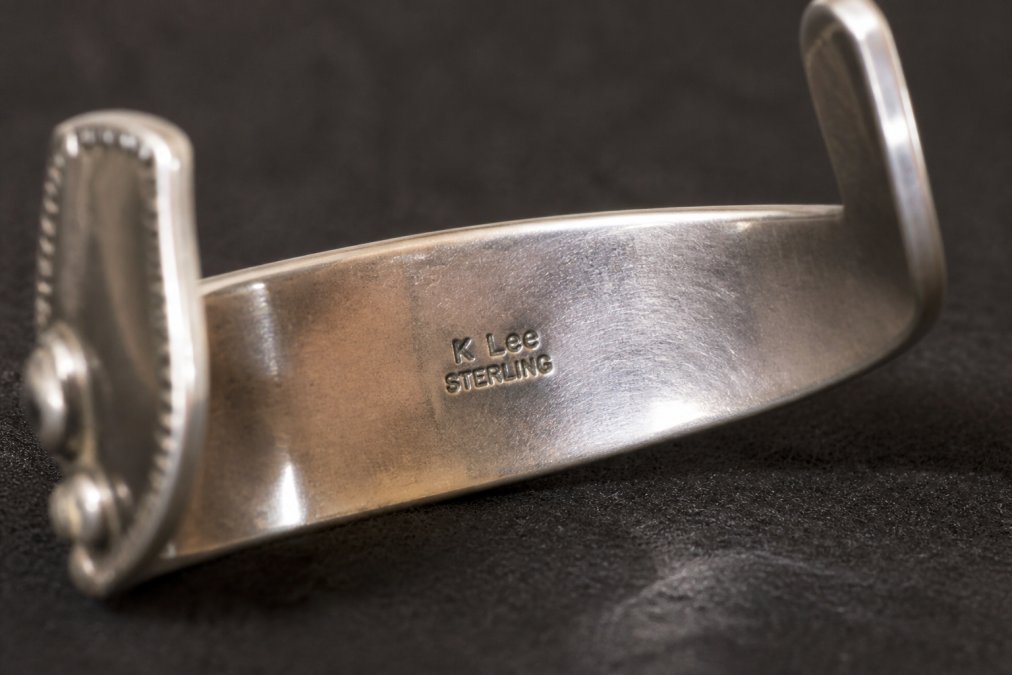
A hallmark is the single most verifiable piece of evidence that a jewelry piece was made by a specific artisan. Authentic Navajo jewelry hallmarks are hand-stamped into the silver using steel dies, and each maker's mark is registered with organizations like the Navajo Nation or documented through trading post records.
Macro-Photography Guide for Reading Hallmarks
Most hallmark identification failures happen because buyers cannot clearly see what they are looking at. Here is a practical approach:
- Use your phone's portrait or macro mode. Hold the piece steady and move the camera within 2-4 centimeters of the hallmark area.
- Add a secondary light source. A small flashlight held at a raking angle across the silver surface creates shadows in the stamped letters, making them dramatically more legible.
- Photograph in RAW or the highest resolution setting available. You can zoom into a high-resolution image without losing detail needed to read a maker's mark.
- Compare against documented hallmark registries. The Heard Museum in Phoenix and several academic resources maintain photographic databases of known Navajo silversmith hallmarks.
A genuine hand-stamped mark shows slight variation in ink depth and letter angle. A laser-engraved fake mark is perfectly uniform, which is precisely what makes it look wrong to a trained eye.
Maker's Marks, Shop Marks, and Tribal Affiliation Stamps
A maker's mark identifies the individual silversmith. A shop mark identifies the trading post or workshop where a piece was produced or sold. Both are legitimate, but they carry different authentication weight. Tribal affiliation stamps, sometimes appearing as a small tribal seal or the letters "NM" for Navajo-made, indicate the artisan's tribal enrollment. Vintage pieces from before the 1970s often carry no hallmark at all, which is historically accurate. For contemporary pieces, the absence of any maker's mark should prompt additional verification.
How to Spot Fake Native American Jewelry
The biggest mistake buyers make is assuming that Southwest-style design equals Native American origin. The tells are in the construction details.
Mass-Produced Imports and Imitation Turquoise
Mass-produced imports typically share several characteristics:
- Cast findings: The clasps, jump rings, and bezels are machine-cast from base metal, then silver-plated. Hand-fabricated pieces show careful, minimal solder application.
- Uniform stamp patterns: Machine-applied stamp work repeats with mechanical precision. Genuine stamp work shows slight rotational variation and inconsistent strike depth.
- Imitation turquoise: Dyed howlite, plastic resin, and reconstituted turquoise powder are all sold as turquoise. Natural turquoise has a matrix pattern that is never perfectly symmetrical. Stabilized turquoise, which is genuine turquoise treated with resin to harden it, is acceptable in the trade but should be disclosed. Reconstituted turquoise, made from turquoise dust and binding agents, should be priced accordingly.
According to the Indian Arts and Crafts Board at the U.S. Department of the Interior, misrepresenting a product as Native American-made when it is not is a federal offense under the Indian Arts and Crafts Act.
Common Chemical Testing Myths
Several popular "home tests" for turquoise and silver circulate online, and most are either inconclusive or destructive.
- The acid test for silver: Nitric acid confirms silver content, but applying it to a finished piece risks permanent damage to the surface patina and surrounding stone.
- The hot needle test for turquoise: Pressing a hot needle against a stone is not a reliable test for natural versus synthetic turquoise and can damage the stone.
- The weight test: Useful as a general indicator for silver content, but not conclusive for stone identification.
The most reliable non-destructive tests are visual: matrix pattern consistency, surface texture under magnification, and color distribution. A gemological appraisal from a certified gemologist is the only truly conclusive method for stone identification.
Indian Arts and Crafts Act Compliance: What Buyers Must Know
The Indian Arts and Crafts Act of 1990 is the primary federal law governing the sale of Native American art and craft objects. Understanding it is essential for serious buyers.
'Navajo-Style' vs. 'Navajo-Made': A Critical Legal Distinction
Navajo-style means the piece was designed to look like Navajo work. It may have been manufactured anywhere in the world by anyone. This term is legal to use in marketing.
Navajo-made means the piece was produced by an enrolled member of the Navajo Nation. Under the Indian Arts and Crafts Act, claiming a product is "Native American-made," "Indian-made," or produced by a specific tribe when it was not is a federal crime. Penalties for commercial violations can reach into the hundreds of thousands of dollars.
When you see "Navajo-style," "Southwestern-inspired," or "Native American-inspired" in a product listing, you are looking at a piece with no legal connection to any Native American artisan. A seller who genuinely works with enrolled Navajo makers will say so explicitly and be able to document it.
Turquoise Quality and Stone Setting in Authentic Navajo Jewelry
Turquoise quality in authentic Navajo jewelry is evaluated across four characteristics: natural versus treated status, hardness, matrix pattern, and color stability.
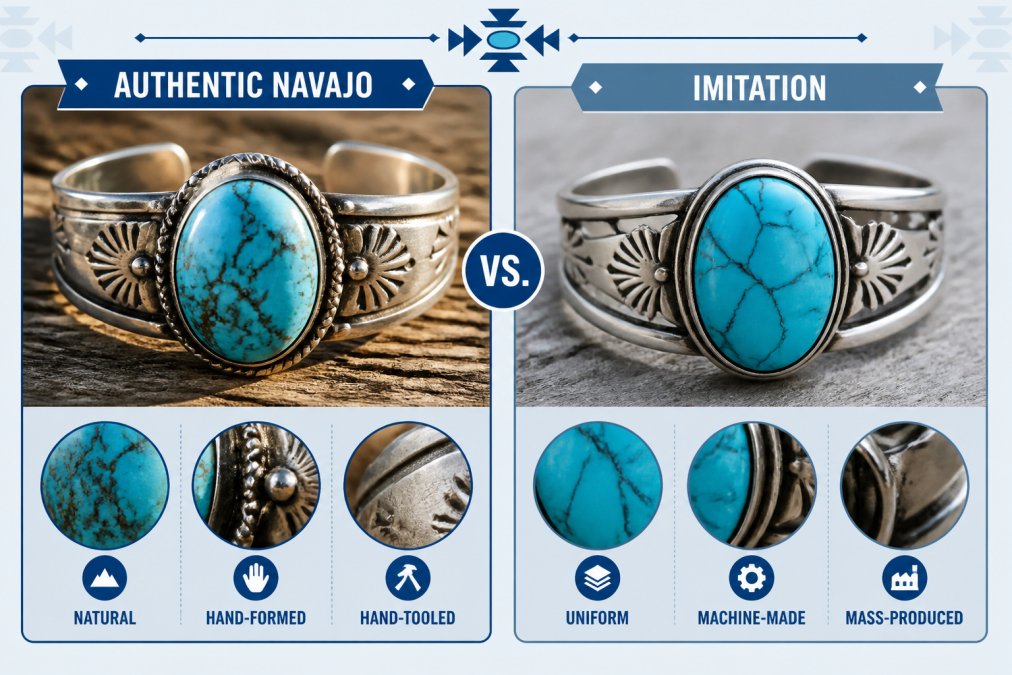
Natural, untreated turquoise is the most valuable. Stabilized turquoise, treated with clear resin to prevent crumbling, is widely used by Navajo silversmiths and is fully legitimate when disclosed. Reconstituted turquoise, made from crushed turquoise powder and binding agents, occupies a lower tier and should be priced and labeled accordingly.
The bezel setting is the most traditional stone-setting method in Navajo work. A hand-formed strip of fine silver is shaped around the cabochon and pressed down to secure it. Hand-formed bezels show slight variation in height and width around the perimeter. Machine-set bezels are perfectly uniform.
Matrix, the veining of host rock within the turquoise, varies by mine of origin. Stones with no matrix at all and a perfectly uniform color are frequently dyed howlite or reconstituted material.
Step-by-Step Authentication Checklist Before You Buy
Use this checklist before committing to any purchase of authentic Navajo jewelry.
| Check | What to Look For | Red Flag |
|---|---|---|
| Silver purity stamp | "925," "Sterling," or "Ster" on the piece | No purity mark present |
| Maker's hallmark | Hand-stamped mark, slight irregularity in strike | Laser-engraved, perfectly uniform mark |
| Construction method | Visible stamp work variation, hand-formed bezels | Perfectly uniform patterns, machine-cast findings |
| Stone disclosure | Seller states natural, stabilized, or reconstituted | No stone disclosure offered |
| Seller documentation | Artisan name, tribal enrollment available | Cannot name the maker |
| Legal language | "Navajo-made" with documentation | "Navajo-style" or "inspired by" |
| Weight and feel | Solid heft relative to size | Unusually light for its dimensions |
| Solder joints | Minimal, precise solder application | Flooded solder across adjacent areas |
Work through this list in order. The first three checks can be done with a smartphone camera and a small flashlight. The remaining checks require a conversation with the seller.
Provenance, Documentation, and Buying From Reputable Sources
Povenance is the documented history of a piece: who made it, when, where it was sold, and through what chain of ownership it has passed. For authentic Navajo jewelry, provenance is the foundation of long-term value.
A reputable source will provide, at minimum, the artisan's name and tribal affiliation. Many established dealers also supply an authenticity certificate that documents the piece's materials, construction method, and maker. According to the Smithsonian's National Museum of the American Indian, understanding the cultural and artisan context of Native American jewelry is central to responsible collecting.
For vintage pieces, trading post receipts, exhibition records, and auction provenance documents all add authentication weight. Buy from sellers who can answer specific questions about specific artisans. If a seller's response to "Who made this?" is a vague reference to "Navajo craftspeople," treat that as a meaningful absence of information. Turquoise Mustang's approach of working with named Navajo and Zuni artisans reflects what responsible sourcing actually looks like in practice.
For buyers seeking additional guidance on the legal framework, the Indian Arts and Crafts Board's official buyer guidance provides clear documentation of consumer rights and seller obligations under federal law.
=== FAQ ANSWERS (audit these too, same rules) ===
[1] Q: Is authentic Navajo jewelry always hallmarked? A: Not always. Many master silversmiths, particularly those working before the 1970s, did not use a consistent maker's mark. Vintage pieces may carry only a sterling stamp or no mark at all. Contemporary bench-made jewelry is far more likely to carry a hallmark or maker's mark, but its absence does not automatically indicate a fake. Weight, construction quality, solder joints, and provenance documentation all matter alongside hallmark identification.
[2] Q: How can I tell if the turquoise in a piece is real? A: Natural turquoise shows matrix variations, slight surface irregularities, and color depth that stabilized or reconstituted stones lack. Stabilized turquoise, treated with resin to harden softer material, is still used by legitimate Navajo artisans and is acceptable when disclosed. Reconstituted turquoise is ground-up material compressed with dye and binders. Plastic or dyed howlite imitations feel lighter and look unnaturally uniform. A reputable seller will disclose stone treatment upfront.
[3] Q: What does the Indian Arts and Crafts Act of 1990 protect buyers from? A: The Indian Arts and Crafts Act of 1990 is a federal truth-in-advertising law enforced by the Indian Arts and Crafts Board under the U.S. Department of the Interior. It prohibits misrepresenting any product as Native American-made when it is not. Sellers who falsely label imported or machine-made jewelry as authentic Navajo or Native American-made face significant civil and criminal penalties. Buyers should look for sellers who can verify the tribal affiliation of their artisans.
[4] Q: What is the difference between 'Navajo-style' and 'Navajo-made' jewelry? A: The distinction is legally significant. 'Navajo-made' means the piece was crafted by an enrolled member of the Navajo Nation. 'Navajo-style' carries no such guarantee, it simply describes an aesthetic. Mass-produced imports from overseas are frequently marketed using style-based language to avoid Indian Arts and Crafts Act violations while still implying authenticity. Always ask a seller to confirm the artisan's tribal enrollment before purchasing authentic Navajo jewelry.
Frequently Asked Questions
Is authentic Navajo jewelry always hallmarked?
Not always. Many master silversmiths, particularly those working before the 1970s, did not use a consistent maker's mark. Vintage pieces may carry only a sterling stamp or no mark at all. Contemporary bench-made jewelry is far more likely to carry a hallmark or maker's mark, but its absence does not automatically indicate a fake. Weight, construction quality, solder joints, and provenance documentation all matter alongside hallmark identification.
How can I tell if the turquoise in a piece is real?
Natural turquoise shows matrix variations, slight surface irregularities, and color depth that stabilized or reconstituted stones lack. Stabilized turquoise, treated with resin to harden softer material, is still used by legitimate Navajo artisans and is acceptable when disclosed. Reconstituted turquoise is ground-up material compressed with dye and binders. Plastic or dyed howlite imitations feel lighter and look unnaturally uniform. A reputable seller will disclose stone treatment upfront.
What does the Indian Arts and Crafts Act of 1990 protect buyers from?
The Indian Arts and Crafts Act of 1990 is a federal truth-in-advertising law enforced by the Indian Arts and Crafts Board under the U.S. Department of the Interior. It prohibits misrepresenting any product as Native American-made when it is not. Sellers who falsely label imported or machine-made jewelry as authentic Navajo or Native American-made face significant civil and criminal penalties. Buyers should look for sellers who can verify the tribal affiliation of their artisans.
What is the difference between 'Navajo-style' and 'Navajo-made' jewelry?
The distinction is legally significant. 'Navajo-made' means the piece was crafted by an enrolled member of the Navajo Nation. 'Navajo-style' carries no such guarantee, it simply describes an aesthetic. Mass-produced imports from overseas are frequently marketed using style-based language to avoid Indian Arts and Crafts Act violations while still implying authenticity. Always ask a seller to confirm the artisan's tribal enrollment before purchasing authentic Navajo jewelry.
Identifying authentic Navajo jewelry takes more than a good eye. It requires understanding material standards, hallmark documentation, federal law, and the construction techniques that distinguish bench-made artisan work from factory imports. Turquoise Mustang curates its collection directly from enrolled Navajo and Zuni artisans, with artisan names and tribal affiliation available for every piece. Explore the collection and get specific answers about the maker behind each piece before you buy.
This article was written using GrandRanker