


Signs of Genuine Zuni Inlay Jewelry
Table of Contents
- Why Authenticity Matters in Zuni Inlay Jewelry
- Sign #1: Hand-Cut Stones and Perfect Flush Surfaces
- Sign #2: The Hallmark: Your Native American Jewelry Hallmarks Guide
- Sign #3: How to Spot Mass Produced Turquoise and Other Stones
- Sign #4: Zuni vs Navajo Jewelry Characteristics: Know the Difference
- Materials That Signal Quality in Genuine Zuni Inlay
- Where to Find Authentic Zuni Inlay Jewelry
- Frequently Asked Questions
Last Updated: September 4, 2026
Why Authenticity Matters in Zuni Inlay Jewelry
The difference between a genuine Zuni inlay piece and a mass-produced imitation often comes down to details you can only see up close. Zuni silversmiths hand-cut stones like turquoise, coral, and jet, then fit them into precise silver channels with a surface so smooth you can barely feel the seams. Learning the signs of genuine zuni inlay jewelry protects your investment and honors the artisans who carry this tradition forward.

At Turquoise Mustang, we work directly with Navajo and Zuni artisans, so we see the difference between authentic stonework and factory reproductions every day. The five signs below will help you buy with confidence, whether you are a first-time buyer or a seasoned collector.
Authentic Zuni inlay jewelry is distinguished by hand-cut stones set flush within sterling silver channels, a clear artist hallmark, and materials that show natural variation rather than uniform perfection.
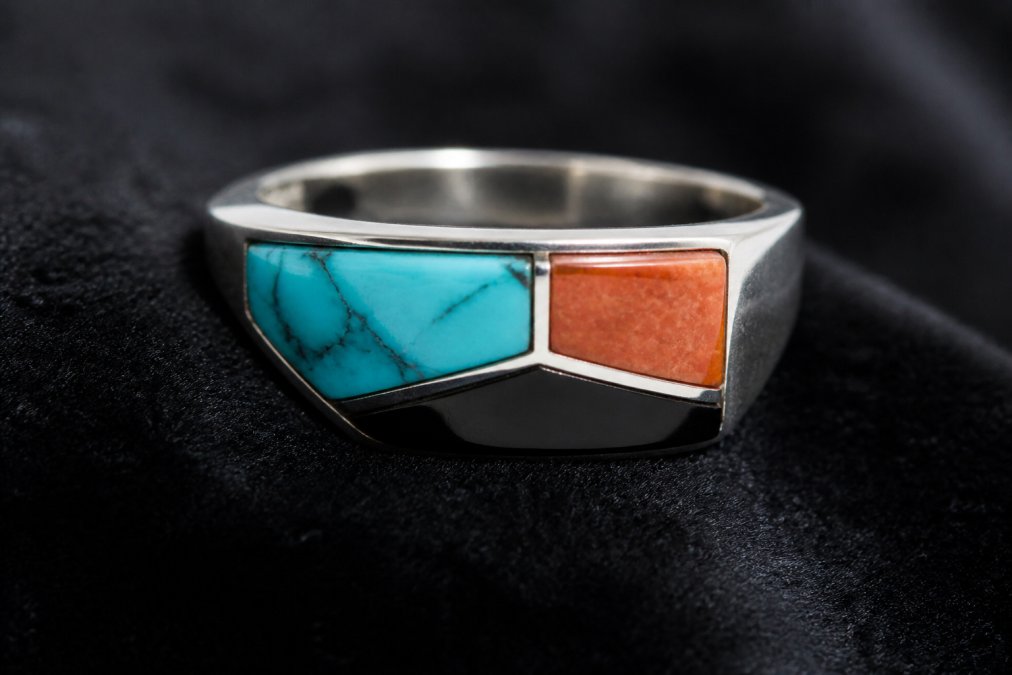
Sign #1: Hand-Cut Stones and Perfect Flush Surfaces
Run your fingertip across the stonework. On genuine Zuni inlay jewelry, the stones sit perfectly flush with the silver channels, creating a surface so smooth it feels almost like glass. This flush surface requires hours of sanding and polishing after the stones are set. Raised edges, gaps, or uneven transitions suggest machine assembly.
Hand-cut stones also show subtle variation. Natural stones have slight differences in color, veining, and texture from one segment to the next, while machine-cut pieces use uniform slabs that repeat identical patterns. Zuni channel inlay requires cutting each stone individually to fit its specific channel. That precision shows in the tightness of the seams, with no light through gaps and no excess adhesive.
Sign #2: The Hallmark: Your Native American Jewelry Hallmarks Guide
A hallmark is the single most reliable indicator of authenticity. Genuine Zuni pieces are stamped with the artist's name, initials, or a family mark, often alongside "Zuni" and "Sterling."
The Indian Arts and Crafts Act requires that jewelry sold as Native American be made by a enrolled member of a federally recognized tribe. A hallmark provides traceability to the individual artist. Look for:
- The artist's full name or recognizable initials
- "Sterling" or "925" indicating sterling silver content
- "Zuni" identifying the tribal affiliation
- A pictograph or symbol unique to the artist or family
Early Zuni pieces from the 1930s through 1950s often carry only a trader's stamp. Individual artist hallmarks became common in the 1970s as the market grew. Pieces with no hallmark require extra scrutiny, though some older works were never stamped.
Sign #3: How to Spot Mass Produced Turquoise and Other Stones
Learning how to spot mass produced turquoise goes beyond recognizing dyed howlite. The most convincing fakes, reconstituted stone, resin-filled slabs, and polymer imitations, require you to look at the material the way a gemologist would.
The UV Light Test: Separating Natural from Plastic
A small UV flashlight (365nm wavelength) is a cheap, decisive tool. Under long-wave UV light, many plastics and resins fluoresce a bright, chalky white or an unnatural neon blue. Natural turquoise typically shows little to no fluorescence, or at most a dull, earthy glow. Reconstituted turquoise, turquoise dust bound with epoxy or polyester resin, often lights up unevenly, with bright spots where the resin pools.
This test is not foolproof. Some stabilized natural turquoise (treated with clear resin to harden porous stone) will show a faint glow. The key is the pattern: a uniform, bright glow suggests high resin content, while a patchy or absent glow is more consistent with lightly stabilized natural material.
Magnification: The 10x Loupe Test for Matrix and Surface
At 10x magnification, the differences between natural and manufactured stone become obvious.
- Natural turquoise matrix (the host rock web) looks organic, with irregular, branching lines that terminate naturally. The matrix is often slightly recessed because it is softer than the turquoise and wears down during polishing.
- Reconstituted stone matrix looks like a uniform speckle or a fine, consistent grain, almost like a printed pattern. It lacks the chaotic, branching structure of natural matrix.
- Dyed howlite or magnesite shows dye concentration in the pores. Look for dark, pinpoint dots of concentrated dye, especially along the edges of the stone where it meets the silver. Natural turquoise does not bleed dye into its setting.
- Plastic imitations often have a perfectly smooth, non-porous surface under magnification, with no natural stone texture. They may also show tiny air bubbles trapped inside, a definitive sign of a cast or molded product.
The Touch and Temperature Test
Natural stone conducts heat away from your skin. Hold the stone to your lips or the inside of your wrist, a genuinely cold sensation that lingers indicates stone. Plastic and resin feel room-temperature almost immediately. This is a quick screening test, useful when you cannot use a loupe.
The Specific Gravity of a Well-Made Piece
Authentic Zuni inlay is dense. The stones are cut thick enough to fill the silver channel completely, and the silver itself is typically 18-20 gauge. Mass-produced pieces often use thinner silver (22-24 gauge) and shallow-cut stones, making the piece feel disproportionately light. If it looks substantial but feels hollow, the inlay is likely shallow.
A Note on Stabilization vs. Substitution
Stabilization is an industry-standard practice for softer, porous turquoise. The stone is impregnated with a clear resin under pressure to harden it. This is still natural turquoise. The problem arises with reconstituted material, crushed turquoise mixed with resin and molded into blocks. Under magnification, reconstituted stone shows a uniform, fine-grained texture with no natural crystalline structure. Ask the seller directly: "Is this natural stabilized stone or reconstituted?"
Sign #4: Zuni vs Navajo Jewelry Characteristics: Know the Difference
Understanding Zuni vs Navajo jewelry characteristics prevents you from paying Zuni prices for Navajo work, or vice versa. While both traditions produce exceptional pieces, their techniques and visual signatures differ significantly.
Visual Signatures: Stonework vs. Silversmithing
Zuni jewelry is defined by its stonework. The Zuni are known for channel inlay, where stones are cut to fit within silver partitions, and for needlepoint and petit point work featuring thin, pointed stone settings. The aesthetic is precise, geometric, and stone-forward, with silver serving as a frame rather than the main attraction.
Navajo jewelry, by contrast, emphasizes the silver itself. Classic Navajo pieces feature heavy stamp work, large turquoise cabochons in simple bezel settings, and techniques like sandcasting and repoussé. A piece combining multiple small stones in complex patterns is almost certainly Zuni. A bold, single-stone cuff with decorative silver stamping is typically Navajo.
The Weight Profile: A Physical Test
Authentic Zuni inlay has a specific weight profile you can feel in your hand. Because the stones are hand-cut to fill the channel completely, and the silver base is substantial enough to hold the mosaic without warping, a genuine piece feels dense and balanced.
- The Heft Test: Hold the piece in your palm and bounce it gently. A genuine Zuni piece feels solid, with no rattling or shifting. The weight is distributed evenly across the piece. A mass-produced piece with thin silver and shallow stones feels disproportionately light, it looks large but weighs almost nothing.
- The Flex Test: Gently press on the center of a cuff or the sides of a ring. Genuine Zuni silver is work-hardened and thick enough to resist flexing. A piece that bends easily under light pressure is made from thin, annealed silver that cannot support a proper inlay.
- The Balance Test: A well-made Zuni ring balances evenly on your finger. The stone mosaic does not make it top-heavy, because the silver shank is substantial enough to counterbalance the stonework. If a ring feels like it is constantly rotating to show the top, the shank is likely too thin for the stone setting.
Construction Details: The Back of the Piece
The back of a Zuni piece is as telling as the front. Authentic channel inlay is set into a solid silver base. Look at the reverse side:
- Solid Backing: Genuine pieces have a solid silver back, not a hollow one. You should not see the stones from the back, nor should you see empty cavities.
- Smooth Finish: The back is typically sanded smooth, even if not highly polished. Rough, unfinished interiors with sharp edges suggest a rushed, mass-produced item.
- Solder Points: On multi-stone pieces, you may see clean, deliberate solder joints where silver partitions meet the base. Messy, blobby solder or visible glue lines are red flags.
The Bottom Line on Tradition
Channel inlay, needlepoint, and petit point are Zuni specialties. Stamp work and large single-stone settings are Navajo signatures. Matching the technique to the tradition helps confirm authenticity, but the physical test, heft, balance, and solid construction, is what separates a genuine heirloom from a piece that merely looks the part.
Materials That Signal Quality in Genuine Zuni Inlay
Sterling silver forms the foundation of quality Zuni inlay jewelry. Check for the "Sterling" stamp and be wary of pieces that feel unusually light or show signs of flaking plating. Traditional Zuni artisans work with sterling silver, not base metals with a silver finish.
The stone palette in traditional Zuni inlay is consistent: turquoise, coral, jet, and mother of pearl appear in nearly every piece. Some artists incorporate other materials like opal, onyx, or shell, as seen in contemporary works. The quality of the stones matters as much as the setting. High-grade turquoise shows rich color and stable structure. Coral should display uniform color without dye bleeding. The Gemological Institute of America's guide to turquoise explains how to evaluate color and matrix quality in natural stones.
Patina and oxidation also signal authenticity. Many Zuni silversmiths intentionally oxidize the silver channels to darken them, creating contrast against the bright stones. This darkening should be even and deliberate. On older pieces, natural patina in recessed areas is a positive sign of age and genuine wear.
Where to Find Authentic Zuni Inlay Jewelry
The safest place to buy genuine Zuni inlay jewelry is from a dealer who works directly with the artists. At Turquoise Mustang, we curate pieces from Zuni artisans like Gloria Tucson and Romero Vacit, and we document the artist behind each piece.
Questions to ask any seller before purchasing:
- Who is the artist, and can you provide their name?
- Does the piece carry the artist's hallmark?
- Can you share the piece's provenance or history?
- Is the turquoise natural, stabilized, or reconstituted?
A reputable dealer answers these questions directly. As with any significant purchase, buy from sellers who specialize in Native American jewelry rather than general gift shops or marketplaces where provenance is unclear. The Indian Arts and Crafts Association maintains a directory of ethical dealers committed to authentic Native American art.
At Turquoise Mustang, our Zuni collection includes pieces ranging from a Zuni Multi-Stone Inlay Stacker Ring, Gloria Tucson, size 7 for $50.00 to an Opal, Onyx and White Buffalo Zuni Inlay Ring by Rick Torino, Zuni, Size 13.5 for $375.00, each with documented artist attribution. We also offer our own proprietary lines of Western jewelry, all sterling silver with authentic stones, clearly hallmarked to distinguish them from Native-made pieces. Whether you are adding to a collection or starting one, authentic Zuni inlay jewelry rewards careful attention with a lifetime of wear.

Frequently Asked Questions
How can you tell if a Zuni necklace is real?
Look for hand-cut stones set flush into precise silver channels with no gaps. Check for a hallmark from the artist or pueblo. Real Zuni pieces use natural stones like turquoise, coral, and jet, and the surface should feel smooth to the touch. Mass-produced pieces often have uniform, machine-cut stones and lack a distinctive maker's mark.
What is the hallmark of Zuni inlay jewelry?
Zuni artists typically stamp their name, initials, or a family symbol into the silver. "Zuni" is often included. This hallmark is your direct link to the artist. While not every older piece is hallmarked, a genuine piece will usually have some form of maker's mark, distinguishing it from commercial or mass-produced Native American-style jewelry.
What are the key differences between Zuni and Navajo jewelry characteristics?
Zuni jewelry is famous for precise, intricate stonework like channel inlay, needlepoint, and petit point, creating detailed mosaics. Navajo jewelry often features larger, single stones, bold silverwork, and stampwork, with turquoise taking center stage. In short, Zuni emphasizes the stone mosaic, while Navajo design often highlights the silver setting.
Are there specific stones commonly used in Zuni inlay?
Yes. Traditional Zuni inlay uses a palette of turquoise, red coral, jet (a type of lignite), and mother of pearl. You may also see white shell and other stones. The combination of these contrasting colors is a hallmark of the style. The stones should be hand-cut to fit the silver channels precisely.
Authentic Zuni inlay jewelry rewards buyers who take the time to verify craftsmanship, hallmarks, and materials. The signs of genuine zuni inlay jewelry are visible to anyone who knows what to look for. Turquoise Mustang offers handcrafted pieces from documented Zuni artisans, with clear artist attribution and quality sterling silver construction. Search our collection to find a piece that honors this remarkable tradition.
This article was written using GrandRanker