


How to Spot Mass Produced Turquoise: A Buyer's Guide
Table of Contents
- Why Mass Produced Turquoise Matters to Collectors
- Stabilized vs. Natural Turquoise: Understanding the Difference
- Visual Inspection Techniques for Authentic Turquoise
- Common Imitation Materials: Howlite, Magnesite, and Synthetic Alternatives
- Testing Turquoise with Acetone and Other Simple Methods
- How to Identify Authentic Native American Jewelry
- Understanding Turquoise Hallmarks and Signatures
- Mine Source and Ethical Sourcing Considerations
Last Updated: August 25, 2026
Why Mass Produced Turquoise Matters to Collectors
Spotting mass produced turquoise has become essential for serious collectors. The market is flooded with imitation stones, heavily treated materials, and synthetic alternatives designed to look convincing. Understanding how to distinguish genuine turquoise from fakes protects both your investment and your integrity as a collector.
The problem isn't that mass production exists, it's that many producers deliberately obscure what they're selling. A stone labeled "turquoise" might be stabilized (natural but chemically treated), reconstituted (crushed fragments bound with resin), or entirely synthetic. Without knowing what to look for, you could spend significant money on something that will degrade within years or never had authentic origins.
At Turquoise Mustang, we work with artisans who source genuine material and apply traditional techniques. This guide breaks down exactly what separates authentic turquoise from mass-produced alternatives flooding the market.
Stabilized vs. Natural Turquoise: Understanding the Difference
Natural turquoise is porous. This defining characteristic is also its primary vulnerability. Because turquoise absorbs oils, moisture, and environmental contaminants, it can fade, crack, or lose its luster over time. Stabilization addresses this by impregnating the stone with resin or wax to seal its pores and increase durability.
Here's where confusion starts: stabilized turquoise is still real turquoise. It's the same mineral (copper aluminum phosphate), just treated to last longer. But stabilization exists on a spectrum, and mass producers often take shortcuts that compromise integrity.
What Stabilization Does to the Stone
Stabilization strengthens turquoise by filling microscopic voids with epoxy resin or wax. This increases hardness, prevents color fading, and makes the stone more resistant to scratches and cracks. In theory, this sounds ideal.
The issue emerges when manufacturers over-stabilize or use low-quality resins. Excessive resin creates a plastic-like appearance, dulling the stone's natural waxy luster. Over time, poor-quality resin yellows, cracks, or separates from the stone, leaving visible gaps or discoloration. Mass producers often prioritize cost over quality, meaning the resin may fail within months of purchase.
Genuine stabilized turquoise uses minimal resin applied precisely to vulnerable areas. The stone retains its natural appearance and color saturation. You won't see a glossy plastic sheen or notice the resin as a separate layer.
Recognizing Resin-Impregnated Turquoise
Resin-impregnated turquoise has a tell-tale appearance. Run your eye across the surface under bright light. Natural or lightly stabilized turquoise has subtle variations in sheen based on the stone's natural structure. Heavily resin-impregnated stones look uniformly glossy, almost like they've been coated with varnish.
Press your fingernail gently against an inconspicuous spot. Natural turquoise and properly stabilized turquoise feel slightly warm with subtle give. Heavily resin-impregnated stones feel cold and hard, more like plastic or glass. This tactile difference is immediate once you've felt the contrast.
Examine the edges where the stone meets the setting. Resin-heavy pieces often show a visible layer pooling at edges or filling gaps where it shouldn't be. Authentic turquoise sits cleanly in its setting with minimal excess material.
Visual Inspection Techniques for Authentic Turquoise
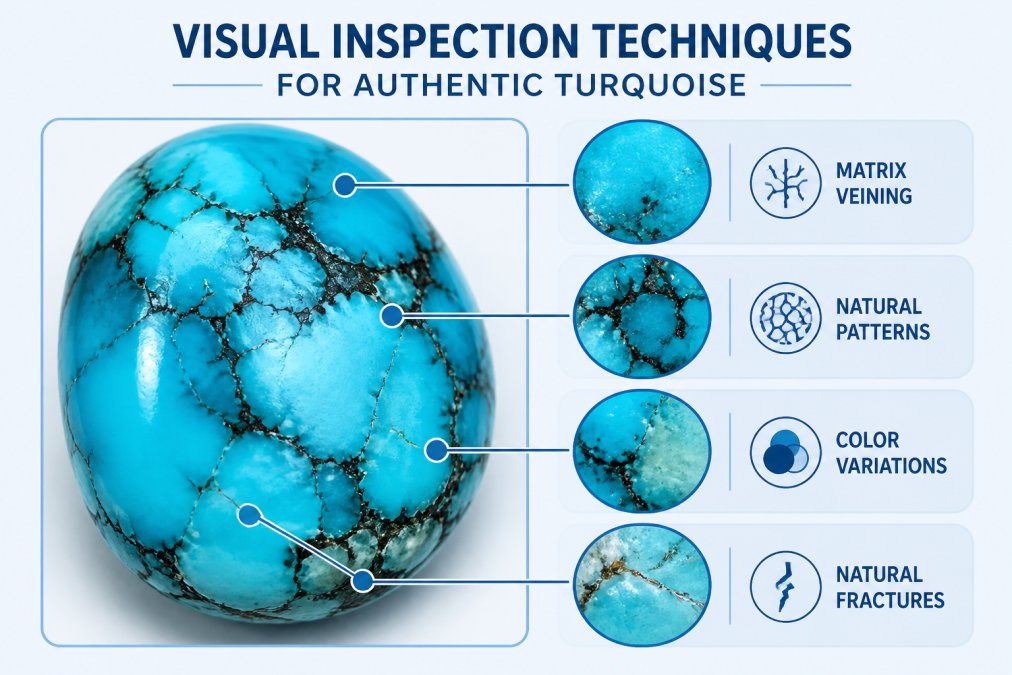
The fastest way to spot mass produced turquoise is through careful visual inspection. You don't need specialized equipment, just good lighting and knowledge of what authentic turquoise looks like.
Color Uniformity and Matrix Patterns
Mass produced turquoise often displays unnaturally uniform color, a red flag. Authentic turquoise varies slightly in hue across the stone, some areas slightly more blue, others more green, depending on mineral composition and formation. This variation gives genuine turquoise its character.
Examine the matrix, the veining and webbing running through the stone. Natural turquoise matrix patterns are organic and irregular, following the stone's natural fracture lines. Mass produced stones, especially synthetic ones, show matrix that's too regular, too symmetrical, or too perfectly distributed. The veins might form geometric patterns or repeat in ways that look computer-generated.
Natural turquoise from different mines has distinct color signatures. Sleeping Beauty turquoise from Arizona tends toward bright sky blue. Kingman turquoise ranges from pale blue-green to deep teal. Carico Lake turquoise displays vivid apple-green tones from zinc in the mineral composition. Mass producers create synthetic versions that hit a generic "turquoise blue" that doesn't match any specific mine's characteristics.
Examining Veining and Natural Fractures
Look closely at how the matrix interacts with the turquoise body. In authentic stones, veining is three-dimensional, sitting at various depths within the stone, creating shadow and depth. The veins themselves are often darker (iron oxide) or lighter (quartz or other minerals) than the surrounding turquoise.
Mass produced stones frequently show matrix that appears flat or painted on the surface. Synthetic turquoise sometimes has veining that looks airbrushed, with soft edges that blend unnaturally. Real matrix has crisp edges where different minerals meet.
Natural fractures in turquoise are another authentication marker. Authentic stones show fine cracks following the stone's natural stress points. These fractures are random and organic. Synthetic or heavily treated stones either have no fractures or show fractures that align too perfectly.
Common Imitation Materials: Howlite, Magnesite, and Synthetic Alternatives
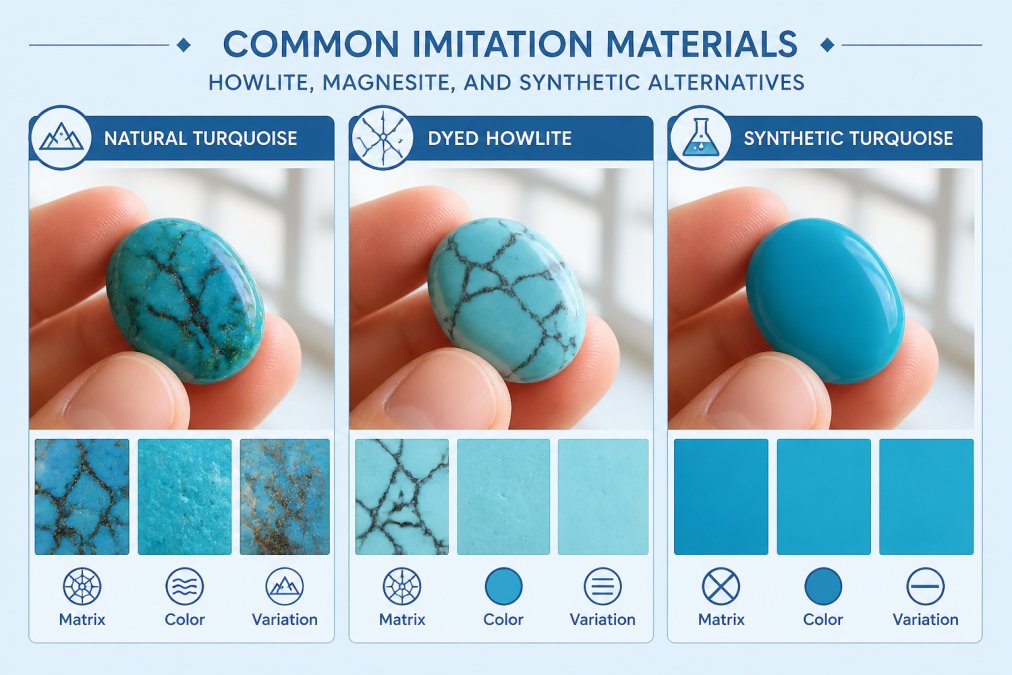
The most common mass produced "turquoise" isn't turquoise at all. Howlite and magnesite are white minerals that dye easily and cost a fraction of genuine turquoise. When dyed blue or green, they're nearly indistinguishable to the untrained eye, but they fail every authenticity test.
Howlite is softer than turquoise (3.5 on the Mohs hardness scale versus turquoise's 5-6) (usgs.gov). It's also more porous, meaning dye penetration is inconsistent. Over time, dyed howlite fades unevenly, leaving pale spots or streaks. The dye can transfer to skin or clothing, especially if wet.
Magnesite is similarly soft and porous. It's often dyed and sold as "turquoise" in mass market jewelry because it's cheaper to produce and easier to cut into uniform shapes. Magnesite lacks turquoise's characteristic matrix patterns, instead showing white veining that's too regular and geometric.
Synthetic turquoise is manufactured in laboratories using copper, aluminum, and phosphate compounds. It's chemically identical to natural turquoise but lacks the organic variation that makes authentic stones beautiful. Synthetic turquoise is often too uniform in color, too perfect in clarity, and too consistent in matrix patterning. It's also frequently over-stabilized, giving it that plastic appearance.
Some mass producers blend crushed turquoise fragments with resin to create "reconstituted" turquoise. This material contains some genuine turquoise, but the binding resin yellows and degrades over time. Pieces made from reconstituted turquoise often show visible seams or layering where fragments were pressed together.
Testing Turquoise with Acetone and Other Simple Methods
You don't need a gemological laboratory to verify turquoise authenticity. Several simple tests reveal whether a stone is genuine, stabilized, or fake.
The Acetone Test Explained
The acetone test is the most reliable home authentication method. Acetone dissolves low-quality resin and dye used in mass produced pieces but doesn't affect genuine turquoise or high-quality stabilization.
Soak a cotton swab in pure acetone (found in nail polish remover or hardware stores). Rub the swab gently on an inconspicuous area, the back, underside, or an edge hidden by the setting. If the stone is dyed howlite or magnesite, blue or green color will transfer onto the swab. If it's low-quality synthetic turquoise with poor resin binding, the resin may soften or the stone may show color transfer.
Genuine turquoise shows no color transfer. High-quality stabilized turquoise also passes this test because the resin used is stable and doesn't dissolve in acetone. This works because genuine turquoise's color comes from copper in its mineral structure, it's part of the stone itself. Dyed imitations rely on surface or shallow dye penetration, which acetone disrupts.
Heat, Scratch, and Hardness Tests
The scratch test reveals a stone's hardness. Genuine turquoise sits at 5-6 on the Mohs hardness scale. Use a steel file or knife edge to gently scratch an inconspicuous area. Howlite and magnesite scratch easily and show white marks. Turquoise resists scratching or shows only faint marks.
The heat test distinguishes plastic-like resin from genuine stone. Hold the piece near (not touching) a heat source like a lighter for a few seconds. Genuine turquoise and properly stabilized turquoise warm gradually and evenly. Heavily resin-impregnated pieces heat quickly and may smell like plastic or burning resin. Synthetic turquoise with poor resin may show visible warping or discoloration.
The weight test is subtle but effective. Genuine turquoise has a specific gravity around 2.6-2.9 (usgs.gov). Howlite is lighter (2.5), magnesite is similar (2.3), and synthetic turquoise varies depending on the resin used. Hold an authentic piece and a suspected imitation of similar size. The authentic stone feels noticeably heavier.
How to Identify Authentic Native American Jewelry
Authentic Native American jewelry, particularly pieces from Navajo and Zuni artisans, represents generations of craftsmanship. Identifying genuine pieces requires understanding the hallmarking system and recognizing quality markers that mass production can't replicate.
Genuine Native American jewelry is hallmarked. The artist stamps their initials or name, often with a tribal identifier or the word "sterling" to indicate silver content. This hallmark is typically found on the back of the piece or inside a ring band. Mass produced pieces either lack hallmarks entirely or carry vague stamps like "925" without artist attribution.
The silverwork itself tells a story. Hand-stamped patterns in authentic pieces show subtle variations, stamps aren't perfectly aligned, some impressions are deeper than others, and the overall pattern has organic flow. This is intentional. Navajo and Zuni artisans use traditional stamp patterns, but each application is unique. Mass produced pieces show perfectly uniform stamping, often created by machine dies.
Soldering and construction reveal authenticity. In handcrafted pieces, solder lines follow the contours of the design. The silver shows patina and age appropriate to the piece's creation date. Mass produced jewelry often has sloppy solder work, visible seams, or overly polished surfaces that look artificially new.
The stone setting is crucial. In authentic pieces, turquoise is typically set in a bezel carefully shaped to fit the individual stone. The silversmith chooses stones that work with the design. Mass produced jewelry uses uniform cabochon cuts set in standardized bezels, with the stone secondary to the pre-designed setting.
Understanding Turquoise Hallmarks and Signatures
Hallmarks serve as the authentication fingerprint of Native American jewelry. Learning to read them is essential for verifying authenticity.
A legitimate hallmark includes the artist's initials or full name, often with a tribal affiliation symbol. Navajo pieces might show "Navajo" stamped alongside the artist's mark. Zuni pieces often display "Zuni" with the artist's initials. These hallmarks are registered with tribal authorities and galleries that authenticate genuine pieces.
Sterling silver content is marked "925" or "sterling," indicating 92.5% pure silver (the FTC). Mass produced pieces often show only "925" without artist hallmarks, a red flag. Genuine Native American jewelry prioritizes artist attribution over generic metal content labeling.
Hallmarks are stamped into the metal during creation, not added later. They're slightly irregular, the stamp may sit at a slight angle or show varying depth. Machine-stamped hallmarks on mass produced pieces are perfectly uniform and precisely centered.
Some artisans use maker's marks, unique symbols or designs identifying their work. These marks are distinctive and consistent across an artist's body of work. If you purchase from the same artisan multiple times, you'll recognize their mark. Mass producers use generic symbols or no marks at all.
Mine Source and Ethical Sourcing Considerations
The turquoise's origin matters for both quality and ethics. Different mines produce turquoise with distinct characteristics, and knowing the source helps verify authenticity while supporting ethical sourcing practices.
Sleeping Beauty turquoise from Arizona is known for bright, uniform sky blue color with minimal matrix. Kingman turquoise from Arizona ranges from pale blue-green to deep teal, often with distinctive birdseye matrix patterns. Carico Lake turquoise from Nevada displays vivid apple-green tones. Morenci turquoise is deep blue with brown matrix. Each mine's signature is distinct enough that experts can identify the source by examining the stone.
Mass producers either use synthetic material (which has no mine source) or source from multiple mines and blend them to create uniform batches. This erases the turquoise's story and connection to place. Authentic pieces often include information about the stone's origin, which mine it came from and when it was sourced.
Ethical sourcing is increasingly important. Legitimate turquoise mining follows environmental regulations and provides fair compensation to mining communities. Mass producers often source from unregulated or exploitative operations, particularly overseas synthetic production.
When purchasing from Turquoise Mustang, ask about stone provenance. Pieces featuring Carico Lake, Kingman, or other named sources can be verified. Artisans typically know where their stones came from and can share that information. Mass produced pieces lack this transparency.
We also offer our own proprietary lines of Western jewelry. These are all sterling, made with a variety of authentic stones and clearly hallmarked to distinguish our products from Native made jewelry.
Spotting mass produced turquoise requires patience and attention to detail, but the skills are learnable. Start with visual inspection techniques, color uniformity, matrix patterns, and fracture characteristics, before moving to acetone and hardness tests. Most importantly, buy from sources that prioritize transparency and artist attribution. Turquoise Mustang specializes in authenticated pieces from Navajo and Zuni artisans, each hallmarked and sourced with full provenance documentation. When you understand what you're looking for, mass produced fakes become obvious, and authentic craftsmanship stands out unmistakably.
Featured Rings from Turquoise Mustang:
- Carico Lake Turquoise Mosaic Inlay Ring by Rita Dawes, Navajo, Size 9: This stunning ring features a large oval mosaic inlay of vivid apple-green Carico Lake turquoise, hand-set in sterling silver by Navajo silversmith Rita Dawes. The unique color is a hallmark of Carico Lake turquoise from Nevada. Discover this heirloom-quality piece: turquoisemustang.com
- Birdseye Kingman Turquoise Ring by Calvin Martinez, Navajo, Size 8.5: Crafted by Navajo silversmith Calvin Martinez, this ring showcases a large oval birdseye Kingman turquoise cabochon with deeply impressed geometric stamp patterns on a heavy sterling silver shank. Birdseye Kingman turquoise is highly collectible for its distinctive circular matrix. Explore this unique design: turquoisemustang.com
- Deep Green Turquoise Ring by Derrick Gordon, Navajo, Size 10.75: Navajo silversmith Derrick Gordon created this substantial men's ring featuring a large oval deep green turquoise cabochon. The rich forest-green color is due to higher iron content, making it a standout statement piece. View this handcrafted ring: turquoisemustang.com
- Corn Maiden Cobblestone Inlay Ring by Aaron John, Navajo, Size 7.5: This heavy sterling silver ring by Navajo silversmith Aaron John features a vertical cobblestone mosaic inlay panel with turquoise, sugilite, coral, and natural stone fragments, evoking the Corn Maiden symbol. The storyteller-style shank is deeply stamped with traditional Navajo imagery. Find this culturally significant piece: turquoisemustang.com
Frequently Asked Questions
Q: What is the acetone test for turquoise, and how do I perform it safely?
A: The acetone test checks whether dyes or resins have been applied to turquoise. Dampen a cotton swab with acetone and gently rub an inconspicuous area of the stone. If color transfers to the swab, the turquoise has been dyed or treated with unstable coatings. Real, stabilized turquoise should show no color transfer. Always work in a ventilated area and test a hidden spot first, as acetone can affect some settings.


Q: How can I tell the difference between stabilized turquoise and mass produced imitations?
A: Stabilized turquoise is natural stone treated with resin to harden porous material, it retains the stone's authentic mineral composition and matrix patterns. Mass produced imitations like howlite or magnesite are different minerals entirely, often dyed to mimic turquoise's color. Examine the matrix: natural and stabilized turquoise show irregular, organic veining; imitations typically display uniform color or artificial-looking patterns. Authentic pieces from Native American artisans like those at Turquoise Mustang will have documentation of their source and maker.
Q: What hallmarks or signatures indicate authentic Native American turquoise jewelry?
A: Authentic Native American jewelry should bear the artist's name, tribal affiliation, and sterling silver hallmark (925). Navajo and Zuni pieces often include maker's marks stamped into the silver. The turquoise itself may be identified by mine source, Kingman, Sleeping Beauty, or Carico Lake turquoise each have distinct characteristics. Reputable sellers like Turquoise Mustang provide detailed artist information and provenance for each piece, connecting you directly to the craftsperson's heritage and skill.
Q: How does mine source affect turquoise quality and value?
A: Turquoise from specific mines has unique mineral composition, color, and durability. Carico Lake turquoise, for example, displays vivid apple-green color from zinc content, while Kingman turquoise is known for its blue tones and distinctive matrix patterns. Stones from depleted or less consistent sources may be more prone to fading or brittleness. Mine documentation adds authenticity and investment value, pieces made with turquoise from recognized mines command higher prices because collectors understand their longevity and rarity.
This article was written using GrandRanker