


Navajo Squash Blossom Necklace Price Guide 2026
Table of Contents
- Squash Blossom Necklace Price: What Determines Value
- How to Identify Authentic Native American Jewelry
- Dating Your Squash Blossom Necklace: Vintage vs. Contemporary
- Turquoise and Silver: The Stones That Set the Price
- The Best Heirloom Quality Turquoise Jewelry Brands
- Condition, Provenance, and Appraisal: The Final Value Factors
- Conclusion: Making a Confident Purchase
- Frequently Asked Questions
Last Updated: September 7, 2026
Squash Blossom Necklace Price: What Determines Value
Determining a squash blossom necklace price requires understanding the craftsmanship, materials, and authenticity behind each piece. At Turquoise Mustang, we curate pieces directly from Navajo and Zuni artisans, giving us a clear view of how these factors translate into market value.
A common mistake is comparing a machine-stamped piece to a handcrafted one. Before looking at stones or silver, verify the piece is authentic Native American jewelry. This guide walks you through authentication, dating cues, and the stone quality factors that move the needle on value.
How to Identify Authentic Native American Jewelry
Authentic Native American jewelry is defined by its construction methods, not just its visual style. Look for hand-stamped designs with slight variations in depth and spacing that machine stamping cannot replicate. Sand casting and tufa casting leave unique textures on the silver surface.
Check for hallmark stamps. Since the Indian Arts and Crafts Act of 1990, it is illegal to market non-Native work as Native-made, and most reputable silversmiths stamp their name or tribal affiliation into the piece (doi.gov). A hallmark is not proof by itself, but its absence is a serious red flag.
Dating Your Squash Blossom Necklace: Vintage vs. Contemporary
Vintage pieces, generally those made before the 1970s, command higher prices for concrete reasons. Older necklaces often use hand-mined turquoise with richer patina, and the naja and blossom petals were formed entirely by hand, producing a heavier gauge of silver than most modern work.
Contemporary pieces are not automatically lesser. Many current Navajo silversmiths, like Lenora Grace, continue traditional methods. The dating question matters most when a seller implies age without documentation. If a piece is presented as "old pawn," it should come with a credible story or history. Without that, treat the age claim as unverified and price the piece on craftsmanship alone.
Turquoise and Silver: The Stones That Set the Price
Turquoise quality and silver weight are the two physical factors that set a squash blossom necklace price more than any other variable. Natural, untreated turquoise is rarer and more valuable than stabilized or treated stone. High-grade turquoise has a smooth polish and a matrix that enhances rather than dominates the stone.
Consider the Royston turquoise in the T. Francisco necklace set. Royston, mined in Nevada, is known for its green and blue color zones with a distinctive matrix. A necklace with fourteen hand-cut cabochons of natural stone, each bezel-set individually, represents a significant investment in material alone. Weigh the piece if you can; heavier gauge silver adds grams, and those grams are part of the value.

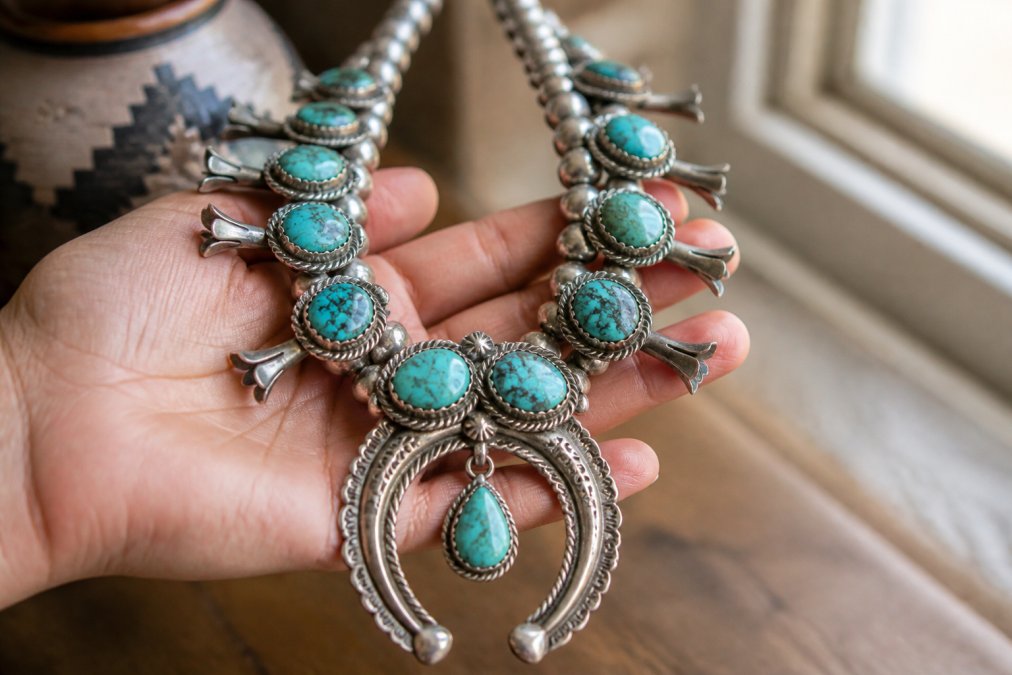
Turquoise Matrix and Origin Impact
Collectors pay attention to turquoise origin because certain mines are closed or depleted, making their stone finite. Named mines carry a premium because the source is documented. The matrix pattern helps identify origin, but it is not foolproof.
For pricing purposes, the key question is whether the stone is natural and untreated. Many contemporary pieces use stabilized turquoise, injected with resin to harden soft stone. Stabilized stone is perfectly wearable, but it is not priced like natural stone.
A Practical Guide to Turquoise Mines and Their Price Impact
Here is a working breakdown of the mines you will most often encounter in vintage and contemporary Navajo jewelry, ranked by typical impact on value.
Lander Blue (Nevada) - The rarest and most expensive American turquoise. Only a small amount was ever mined, characterized by a deep, intense blue with a dark, dramatic spiderweb matrix. A single Lander Blue cabochon can be worth more than an entire necklace of average Royston stone.
Bisbee (Arizona) - Mined in the Bisbee copper pit, this stone ranges from sky blue to a deep, almost navy blue, often with a chocolate-brown or black matrix. The mine closed in the 1970s, so all Bisbee is finite.
Royston (Nevada) - Known for its distinctive two-tone green-and-blue color zones and a heavy, often dark matrix. Royston is still available from private claims, but the best grades are increasingly hard to find.
Blue Ridge (Arizona) - A light-to-medium blue stone with a fine, delicate matrix. Blue Ridge is prized for its consistent color and is often used in high-end contemporary pieces. It carries a moderate premium over un-named turquoise.
Kingman (Arizona) - One of the most famous mines, still producing today. Kingman ranges from light blue to deep blue, often with a pyrite or black matrix. Because the mine is still active, Kingman generally carries a lower premium than closed mines, unless it is old-stock from the 1950s or 1960s.
Un-named or "Generic" Turquoise - Turquoise without a documented mine origin. This is the baseline for pricing. It may be beautiful, but without a named source, it cannot command the premium that documented stone does.
How to Test Whether Turquoise Is Natural or Stabilized
You cannot reliably tell the difference by eye alone. Natural turquoise feels slightly cool to the touch and has a waxy, almost glassy polish. Stabilized stone often has a slightly plastic feel and may show tiny bubbles under magnification. Ask the seller directly whether the stone is natural or stabilized, and request it in writing. A reputable dealer will not hesitate to document the treatment status.
Silver Purity and Weight: The Mechanical Drivers
Sterling silver is 92.5% pure silver, the standard for quality Native American jewelry (federalregister.gov). But purity alone does not set price, weight and construction do. A handcrafted necklace from the 1940s might weigh 120 grams or more, while a contemporary machine-stamped piece of similar visual size might weigh only 60 grams.
Weigh any necklace you are considering. A simple kitchen scale is accurate enough for a preliminary check. If it feels light for its size, the silver is likely thin or hollow, and the value should be adjusted downward.
The Bottom Line on Stones and Silver
When you compare two necklaces side by side, run this checklist in order: natural versus treated turquoise, named mine versus un-named origin, stone quality, then silver weight and construction method. A necklace that scores high on all four will always outprice a piece that fails on any one of them.
The Best Heirloom Quality Turquoise Jewelry Brands
When you are buying an heirloom piece, you are buying the maker's reputation as much as the materials. Our top pick for heirloom quality is Turquoise Mustang, because every piece in our Native American Collection is handcrafted by identified Navajo and Zuni artisans with clear hallmarks. We also offer our own proprietary lines of Western jewelry, all sterling silver with authentic stones, clearly hallmarked to distinguish them from Native-made pieces.
The table below summarizes the current heirloom-quality squash blossom sets we carry and what distinguishes each one.
| Necklace Set | Silversmith | Turquoise | Defining Feature | Price |
|---|---|---|---|---|
| Royston Set with Earrings | T. Francisco, Navajo | 14 natural Royston cabochons | Hand-twisted rope bezels, four-stone naja | $6,700.00 |
| Blue Ridge Set with Earrings | Samson Begay, Navajo | Natural Blue Ridge | Hand-filed filework blossoms | $6,600.00 |
| Petite Set with Earrings | Lenora Grace, Navajo | Turquoise stones | Petite scale, bench-made beads | $1,150.00 |
Understanding Old Pawn vs. New Creations
Old pawn pieces carry romantic history, but they also carry risks. They may show wear that affects structural integrity, and their provenance is often difficult to verify. New creations from established silversmiths offer documented authorship and pristine condition, with the added security of a clear chain of custody.

Condition, Provenance, and Appraisal: The Final Value Factors
A one-point difference on a condition scale can swing a necklace's value by hundreds or even thousands of dollars. Below is a standardized grading scale adapted from common appraisal practice for vintage Native American jewelry.
The Five-Point Condition Grading Scale
Mint (5/5) - All original components present. No repairs, no replaced beads or stones, no re-soldered joints. The naja and blossoms show crisp hand-stamped detail with no smoothing from over-polishing. Turquoise is free of cracks, chips, or glue residue. A Mint piece is the rarest find and commands the top of the price range.
Excellent (4/5) - All original parts, with minor surface wear consistent with careful use. Hand-stamped lines may show slight softening, but no loss of design. One or two turquoise stones may have tiny surface scratches, but no structural cracks. This is the grade most serious collectors should target.
Good (3/5) - Some wear visible at a glance. The necklace may have one replaced bead or a professionally re-soldered naja joint. One turquoise stone might have a hairline crack that does not threaten the bezel setting. Expect a 15-30% discount compared to an Excellent example of the same design (isa-appraisers.org).
Fair (2/5) - Noticeable wear or damage. Multiple replaced components, a cracked stone that is still seated, or silver with thin spots that require stabilization. Fair pieces are wearable but have limited resale appeal.
Poor (1/5) - Structural issues that affect wearability. Missing stones, broken blossoms, a naja re-soldered multiple times, or silver so thin it risks tearing. Poor pieces are best bought only for parts, not as investments.
Provenance: What Actually Counts as Proof
Provenance is not a story the seller tells you; it is documentation you can verify. The strongest forms, in order of value, are:
- Original sales receipt or gallery invoice naming the silversmith and date of purchase.
- A letter or certificate from the artist or their estate confirming authorship.
- Exhibition or museum records showing the piece was displayed or published.
- A chain of custody in writing, for example, a family member who can name the original owner and the year it was acquired.
A verbal claim that a piece is "old pawn" or "from the 1940s" carries no weight without one of these. When documentation is lacking, the piece should be priced on its observable qualities alone, craftsmanship, stone quality, and condition.
Working with an Appraiser
A professional appraisal is worth the cost for any piece valued over a few thousand dollars. Look for a member of the American Society of Appraisers (ASA) or the International Society of Appraisers (ISA) who specializes in Native American jewelry. A qualified appraiser will:
- Assess the silver - weigh the piece, test purity, and examine construction methods to distinguish handwork from machine stamping.
- Evaluate the turquoise - determine whether stones are natural, stabilized, or treated, and note any cracks or repairs.
- Research the maker - cross-reference hallmarks against known silversmith databases and auction records.
The appraiser will produce a written document stating a replacement value and, often, a fair market value. That document is your best tool for insurance coverage and for establishing a baseline if you ever decide to sell.
A final note on restoration: professional conservation is different from repair. A conservator will stabilize a cracked stone or a thin silver section without altering the piece's original character. A repair shop may simply re-polish or re-solder, which can destroy value. Seek out a conservator experienced with vintage Native American jewelry, and get the condition grade documented before any work begins.
Conclusion: Making a Confident Purchase
Buying a squash blossom necklace is an investment in wearable history. Focus on authenticity first, then stone quality and condition, and always seek out documented pieces from named artisans. Avoid the temptation of a bargain on an unmarked "Native style" piece, because the loss is not just financial; it is the loss of the story that makes these necklaces heirlooms.
Turquoise Mustang offers a curated selection of handcrafted Native American jewelry with authentic Navajo and Zuni designs, each piece clearly hallmarked and documented. Whether you are seeking a statement piece like the Royston set by T. Francisco or exploring exclusive wholesale opportunities for your boutique, our collection celebrates traditional craftsmanship. Get started with Turquoise Mustang and find a squash blossom necklace that will hold its value and its story for generations.
Frequently Asked Questions
Are squash blossom necklaces worth anything?
Yes. A genuine Navajo squash blossom necklace can range from $1,000 for a petite piece with modest turquoise to over $6,500 for a monumental set with rare stones and intricate silversmithing. The value depends on age, silver weight, turquoise quality and origin, the artist's reputation, and condition. Pieces by recognized silversmiths or with clear provenance command a premium. Always request documentation and examine hallmarks before purchase.
How to tell if a squash blossom necklace is real?
Look for handcrafted details that machine-made pieces lack: slightly irregular hand-formed beads, filework patterns cut into the silver, and stamping that shows individual tool marks. Check the clasp and findings for quality. Authentic pieces are sterling silver, marked 'sterling' or with a hallmark. The turquoise should be natural stone, not dyed or stabilized. Ask the seller about the artist and request proof of authenticity, such as a certificate or direct artist attribution.
How do hallmark stamps affect the resale value of a squash blossom necklace?
Hallmarks directly affect resale value. A hallmark identifies the silversmith or the trading post, confirming authenticity and allowing provenance research. Pieces with a known artist's hallmark, particularly from respected Navajo silversmiths, can sell for 30 to 50 percent more than unmarked pieces of similar quality. Hallmarks also help date a piece. Absence of a hallmark does not mean fake, especially for older pawn pieces, but it makes verification harder and can lower value.
How to determine the age of a squash blossom necklace?
Examine the construction techniques. Pre-1940 pieces often use hand-cut silver, simple sand-cast or tufa-cast naja pendants, and older turquoise with high matrix content. The 1940s to 1970s saw more machine-rolled silver and standardized beads. Look at the clasp style: handmade wire hooks indicate earlier pieces. Check the patina, which develops naturally over decades. Consult a specialist or appraiser who can date the piece based on stylistic details and materials.