


How to Identify Authentic Squash Blossom Necklaces
Table of Contents
- Why Authenticity Matters in Squash Blossom Necklaces
- Signs of Handmade vs Machine Made Jewelry
- Your Native American Jewelry Hallmarks Guide
- How to Spot Mass Produced Turquoise
- A Closer Look at the Naja and Blossom Construction
- Documenting Provenance for Your Collection
- Your Next Step: Finding a Necklace You Can Trust
- Frequently Asked Questions
Last Updated: September 5, 2026
Why Authenticity Matters in Squash Blossom Necklaces
A squash blossom necklace is a wearable record of Navajo silversmithing tradition that began in the late 19th century. Learning how to identify authentic pieces protects you from overpaying for imports and ensures you are honoring the artisans who carry this craft forward. This guide from Turquoise Mustang, which works directly with Navajo and Zuni artists, walks through the physical clues that separate heirloom-quality work from machine-made lookalikes.

Mass-produced imitations flood the market, often using cast silver and stabilized stone that mimic handwork at a fraction of the cost. Below, we show you how to examine construction, hallmarks, turquoise, and provenance so you can buy with confidence.
Signs of Handmade vs Machine Made Jewelry
The fastest way to judge a piece is to look at how the silver was worked. Handmade Navajo jewelry shows the maker's hand in every surface, while machine-made pieces reveal casting seams and uniform repetition. Most of the telling details are smaller than a grain of rice.
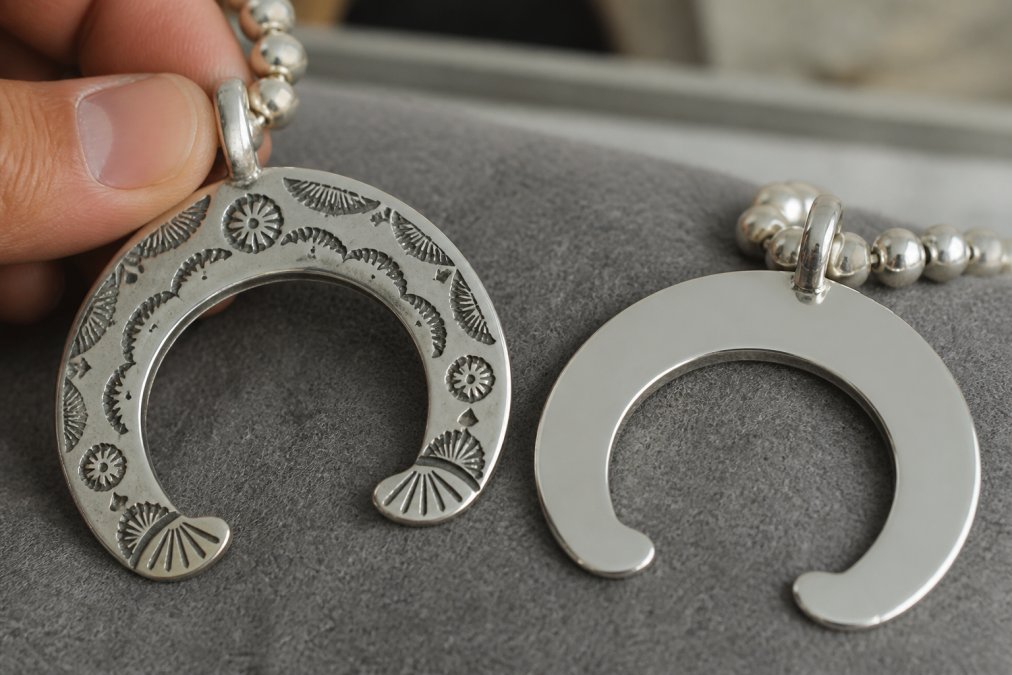
A Macro-Photography Guide to Solder Joints and Bead Seams
A 10x jeweler's loupe or a smartphone camera with a macro lens will reveal more than your eyes ever could. Here is what to look for at each critical junction.
Solder Joints: On a handmade piece, the solder flows and pools at the joint, creating a subtle, irregular fillet. Under magnification, you will see tiny pits, slight color variations, and a soft, blended transition between solder and parent metal. Machine-made pieces show either a perfectly clean, invisible joint because the blossom was cast as a single unit, or a sharp, recessed line where a separate cast component was joined. A mold line, a faint, raised ridge along the center of a bead or blossom, indicates a cast piece never hand-finished.
Bead Seams: Hand-formed Navajo pearls are created by soldering a silver sheet into a tube or joining two hemispheres, leaving a seam. On authentic pieces, this seam is visible but refined, following the curve of the bead. On mass-produced beads, the seam is either absent (because the bead was cast as a hollow sphere) or a crisp, perfectly straight line meeting at a sharp edge, a sign of a die-stamped or machine-joined component.
Stamping Details: Hand-stamped designs are applied with a punch and hammer, so the depth of the impression is not perfectly uniform. The bottom may be slightly rounded, and edges may show a tiny raised lip where silver was displaced. Machine-stamped or laser-etched designs have perfectly flat, uniform bottoms and razor-sharp edges, lacking the organic look of a hand-punched mark.
The Weight and Feel of Sterling Silver
Pick the necklace up. A genuine sterling silver squash blossom necklace has substantial heft because the blossoms are hollow-formed from thick silver sheet. Machine-made counterparts often feel surprisingly light. A typical vintage necklace with 10 to 12 blossoms and a substantial naja will feel weighty, often 150 to 250 grams. A mass-produced import of similar size might feel closer to 80 to 120 grams because the metal is thinner.
Check for the "sterling" mark, but understand its limits. Many imports are stamped with "925" or "sterling" to pass casual inspection. Handmade pieces develop a rich, warm patina over time, while base-metal fakes may tarnish unevenly or feel slippery and cold. A magnet test is a safe first check: sterling silver is not magnetic, so a strong pull indicates a ferrous core or base metal. Test the blossoms and the naja, not the clasp, which may contain a steel spring.
Your Native American Jewelry Hallmarks Guide
Hallmarks are your second line of defense, though they require careful interpretation. A hallmark is a stamp applied by the silversmith, including the artist's name, initials, a pictorial symbol, or a tribal designation like "Navajo" or "Zuni."
Not every authentic piece is hallmarked. Older vintage and "old pawn" necklaces frequently carry no signature at all. The absence of a hallmark does not mean the piece is fake, just as a hallmark alone does not guarantee authenticity, since stamps are easy to replicate. Hand-stamped hallmarks produce slightly uneven, shallow impressions; machine-engraved or deeply laser-etched marks are a red flag for modern production.
A common mistake is treating a hallmark as the only proof you need. In practice, you should use it as a starting point, then verify the construction and materials align with the claimed origin.
How to Spot Mass Produced Turquoise
Authentic turquoise is the heart of a quality necklace, and knowing how to spot mass produced turquoise will save you from the most common pitfall in this market. Real turquoise is a porous stone that is often stabilized, while imitation turquoise is plastic, ceramic, or dyed howlite.
Understanding Turquoise Types and Stabilization
Turquoise is a hydrated phosphate of copper and aluminum. High-grade turquoise from mines like the Sleeping Beauty Mine in Arizona is hard and dense enough to be cut and polished without treatment (nps.gov). Lower-grade, chalky turquoise is soft and porous, and it is routinely stabilized by forcing a clear resin into the stone under pressure. This is an accepted industry practice, and most turquoise on the market today, including in high-end Native American jewelry, is stabilized.
The problem arises when you encounter imitation materials. Here is a breakdown of what you are likely to see:
- Dyed Howlite: Howlite is a white, porous mineral that is easily dyed to mimic turquoise's blue or green hues. Under magnification, dyed howlite often shows a dark, web-like matrix that looks like a lightning bolt or a spider web, which is the dye concentrating in the stone's natural fractures. It is also lighter in weight than turquoise.
- Reconstituted Turquoise: This is made from turquoise dust or low-grade chips that are mixed with a resin binder and pressed into blocks. It can look convincing at a glance, but the matrix is often too uniform and evenly distributed, lacking the chaotic, organic patterns of natural stone.
- Plastic or Ceramic Imitations: These are the easiest to spot. They are often too uniform in color, have a waxy or glassy luster, and feel unnaturally smooth and warm to the touch.
Safe, Non-Destructive Testing Methods
A more reliable set of non-destructive tests includes:
- The Magnification Test: Use a 10x loupe. Look for the telltale signs of dye concentration in the cracks and pits of a stone (indicating dyed howlite). Look for tiny air bubbles or a plastic-like swirl pattern (indicating reconstituted stone or plastic). Natural turquoise will show a more chaotic, organic matrix and a slightly matte, porous surface.
- The Weight Test: Real turquoise is denser than most imitations. A large, thick cabochon of real turquoise will feel noticeably heavier than a similarly sized piece of dyed howlite or plastic. This is best judged when comparing two stones side-by-side.
- The UV Light Test: Some stabilizers and dyes will fluoresce under a long-wave UV (black) light. While not all treated stones will glow, a strong, unexpected fluorescence in a stone that is supposed to be natural is a red flag. This test is non-destructive and can be done with a small, inexpensive UV flashlight.
- The Bezel Examination: Examine the bezel setting closely. Handmade pieces use a hand-built bezel that hugs the stone tightly, with the silver pushed over the stone's edge in a series of small, overlapping burnishing marks. Mass-produced pieces often use a glued or cast bezel with visible gaps, or the stone is set on a pre-formed bed with no hand-finishing.
The Tooth Test: A Caveat
Run the stone across your teeth. Real turquoise feels slightly porous and gritty, while plastic and dyed howlite feel smooth and slick. This test is useful as a quick screening tool, but it is not foolproof: heavily stabilized turquoise can feel smooth, and some high-grade, polished turquoise can also feel slick. Use it as a single data point, not a definitive answer.
A common mistake is treating a single test as conclusive. Use a combination of visual inspection, weight, and magnification to build a case for or against authenticity.
A Closer Look at the Naja and Blossom Construction
The naja, the horseshoe-shaped pendant at the center of the necklace, is the most important element to examine. Traditional najas are hand-made using one of three methods: sand-casting, tufa-cast, or fabricated from silver sheet and wire.
Sand-cast and tufa-cast najas are poured in molds carved from stone, leaving a grainy surface texture impossible to replicate with machine casting (heard.org). Fabricated najas are built up from soldered wires and sheet, showing crisp edges and hand-stamped designs. Examine the center of the naja for a hand-stamped design or a small turquoise cabochon in a hand-made bezel. The blossoms themselves should be hollow, formed from two or more pieces of silver soldered together. Squeeze them gently; they should feel solid but slightly flexible, not thin and brittle.
The Heard Museum's guide to identifying Native American jewelry explains that the quality of the naja's attachment is a strong indicator of overall craftsmanship. On authentic pieces, the naja is attached with a sturdy, well-executed solder joint that has been cleaned and finished. On imitations, the joint is often sloppy or hidden under a decorative cap. The gauge, or thickness, of the silver is also telling. Authentic vintage pieces use heavier gauge silver that resists bending, while many modern imports use a lighter gauge to cut costs.
Documenting Provenance for Your Collection
Provenance is the documented history of a piece and the single most powerful tool for verifying authenticity. A necklace with clear provenance, a receipt from a reputable dealer, an artist's certificate, or a photograph of the maker, is worth significantly more than an identical unsigned piece.
Always ask the seller for documentation. A reputable dealer should be able to tell you the artist's name, tribal affiliation, and approximate year the piece was made. Be wary of vague answers like "it's from a collection" or "we bought it in the Southwest." For high-value pieces, seek an independent appraisal from a specialist in Native American art, adding a third-party layer of verification invaluable for insurance and resale.
Your Next Step: Finding a Necklace You Can Trust
Identifying an authentic squash blossom necklace combines material knowledge, close observation, and a healthy dose of skepticism. You now have the tools to examine solder joints, weigh the silver, read hallmarks, and assess turquoise quality. The final piece is finding a seller who values craftsmanship as much as you do.
At Turquoise Mustang, we work directly with Navajo and Zuni artists, and every piece in our collection is presented with the artist's name and story. We offer handcrafted pieces like the Navajo Pearl & Cloud Mountain Turquoise Squash Blossom Necklace with Pilot Mountain Naja by EL Billah, or the monumental Royston Turquoise set by T. Francisco, each hallmarked and crafted with traditional methods. We also offer our own proprietary lines of Western jewelry, all sterling silver with authentic stones, clearly hallmarked to distinguish them from Native-made pieces.

Frequently Asked Questions
How can you tell if turquoise is genuine or stabilized?
Genuine, untreated turquoise has a porous surface that feels slightly chalky and may absorb a drop of water quickly. Stabilized turquoise has been pressure-treated with resin to harden it, so it feels smooth and waxy, and water beads on the surface. Many contemporary artisans use stabilized stone because it is more durable for everyday wear. Ask the seller directly whether the stone is natural, stabilized, or imitation, and look for a detailed description that names the specific mine, such as Royston or Blue Ridge.
Why do some authentic squash blossom necklaces lack hallmarks?
Older pieces, particularly those made before the 1940s, often lack hallmarks because silversmiths did not routinely sign their work. The Indian Arts and Crafts Act of 1935 encouraged, but did not require, makers to mark their pieces. Many unsigned vintage necklaces are still fully authentic and handmade. When a hallmark is absent, verify authenticity by examining the construction: irregular solder joints, hand-stamped designs, and the weight of the silver are strong indicators of handmade origin.
How much is a vintage squash blossom necklace worth?
Value depends on age, artist attribution, materials, and condition. A vintage piece with a documented hallmark from a known Navajo silversmith can command thousands of dollars, especially if it features natural, high-grade turquoise. Contemporary heirloom-quality necklaces from recognized artisans typically range from $2,000 to over $6,000. For example, a new necklace with 14mm Cloud Mountain turquoise and eight handmade blossoms is priced at $2,295, while a set with rare Royston turquoise can reach $6,700.
What are the signs of mass-produced turquoise jewelry?
Mass-produced turquoise jewelry often uses imitation materials like dyed howlite or plastic, which lack the natural matrix and color variation of genuine stone. The silver components are typically cast, showing smooth, uniform edges and no visible tool marks. Solder joints are clean and invisible, and the piece feels lighter than expected for its size. Look for repetitive patterns and identical details across multiple pieces, which indicate a factory mold rather than the individual hand-stamping of an artisan-made necklace.
Finding a necklace you can trust comes down to education and partnership. You have done the educational work by reading this guide. For the partnership, choose a dealer who is transparent about their sourcing and who supports the artisans behind the work. Explore our curated collection of authentic squash blossom necklaces and find a piece with a story worth wearing.
This article was written using GrandRanker