


Is the Jewelry Native American Website Legit?
Table of Contents
- How to Verify a Native American Jewelry Website Is Legitimate
- Red Flags That Signal a Counterfeit or Mass-Produced Seller
- How to Spot Mass-Produced Turquoise and Identify Quality
- Identifying Authentic Navajo Jewelry Hallmarks and Silversmithing
- Where to Buy Authentic Native American Jewelry Online
- How to Report Fraudulent Native American Jewelry Websites
- Frequently Asked Questions
Last Updated: August 31, 2026
How to Verify a Native American Jewelry Website Is Legitimate
Buying authentic Native American jewelry online requires more than trusting a polished website. The market for handcrafted pieces has exploded, and with it, so has the problem of counterfeit sellers passing off mass-produced imports as authentic tribal work. Verifying authenticity is entirely possible if you know what to look for.
At Turquoise Mustang, we've spent years sourcing directly from Navajo and Zuni artisans, and we've learned exactly what separates legitimate sellers from fraudulent ones. The difference often comes down to documentation, hallmarks, stone quality, and the seller's willingness to provide artist attribution. This guide walks you through the verification process step by step.
Check for Indian Arts and Crafts Act Compliance
The federal Indian Arts and Crafts Act makes it illegal to market or sell any item as "Native American made," "Indian made," or using tribal names (Navajo, Zuni, Hopi, etc.) unless the item was actually made by a member of a federally recognized Indian tribe. Violating this law carries serious penalties, including fines up to $250,000 and criminal prosecution.
A legitimate Native American jewelry website will clearly state this compliance. Look for language like "Made by enrolled members of the Navajo Nation" or "Created by certified Zuni artisans." Generic claims like "inspired by Native American designs" or "Native-style jewelry" are legally safe ways to describe mass-produced pieces, exactly what sellers use when they're not working with tribal artisans.
Ask the seller directly: Can they provide the artist's tribal enrollment number or certificate? Legitimate sellers have this documentation readily available. If they deflect or claim it's "proprietary information," that's a red flag.
Verify Seller Credentials and Artist Attribution
Authentic Native American jewelry websites should provide artist names, tribal affiliations, and biographical information. When you visit a reputable seller's website, you should find the artist's full name and tribal enrollment status, photographs of the artist or their studio, a biography explaining their design philosophy, and specific hallmarks tied to individual makers.
If a website shows beautiful jewelry but lists artists only as "Navajo artisan" or "Zuni craftsperson" without names, that's a warning sign. Legitimate artisans are proud of their work and want credit. Check whether the seller belongs to professional organizations like the Native American Artisan Collective directory, which maintains a verified list of authentic sellers and artisan cooperatives.
Red Flags That Signal a Counterfeit or Mass-Produced Seller
Certain patterns consistently indicate fraudulent or mass-produced operations. Learning to spot these red flags will save you money and protect you from supporting sellers who exploit the Native American jewelry market.
Pricing and Production Claims That Don't Add Up
Hand-crafted jewelry takes time. A single Navajo silver cuff bracelet typically requires 15-30 hours of labor. A genuine squash blossom necklace with turquoise or coral settings can take 40-60 hours. When you see prices that seem impossibly low for the claimed craftsmanship, the math doesn't work.
Red flags include authentic pieces priced significantly lower than comparable work from verified artisans, claims of "wholesale direct" pricing that undercut all other legitimate sellers, "handmade" labels on pieces that show identical design across dozens of listings, promises of custom work with unrealistically fast turnaround times, and bulk inventory of "rare" or "one-of-a-kind" pieces. Mass-produced jewelry from overseas manufacturers often arrives with minimal markup and gets relabeled as authentic. If a turquoise bracelet costs far less than comparable hand-crafted work, the seller is either lying about the origin or using synthetic materials.
Poor Documentation and Vague Artist Information
Legitimate sellers document their sourcing with certificates of authenticity, artist names and dates, photographs of the artist or workspace, clear explanation of materials and techniques, and contact information for the artist. Fraudulent sellers hide behind vague language like "inspired by traditional Native American designs," "Native-style jewelry," or "artist name available upon request." If an artist made the piece, their name should be proudly displayed. If you ask directly and the seller gets evasive, move on.
How to Spot Mass-Produced Turquoise and Identify Quality
Turquoise is the heart of authentic Native American jewelry, and it's also the easiest material to fake. Understanding the difference between genuine turquoise, treated turquoise, and synthetic imitations will improve your ability to evaluate any piece.
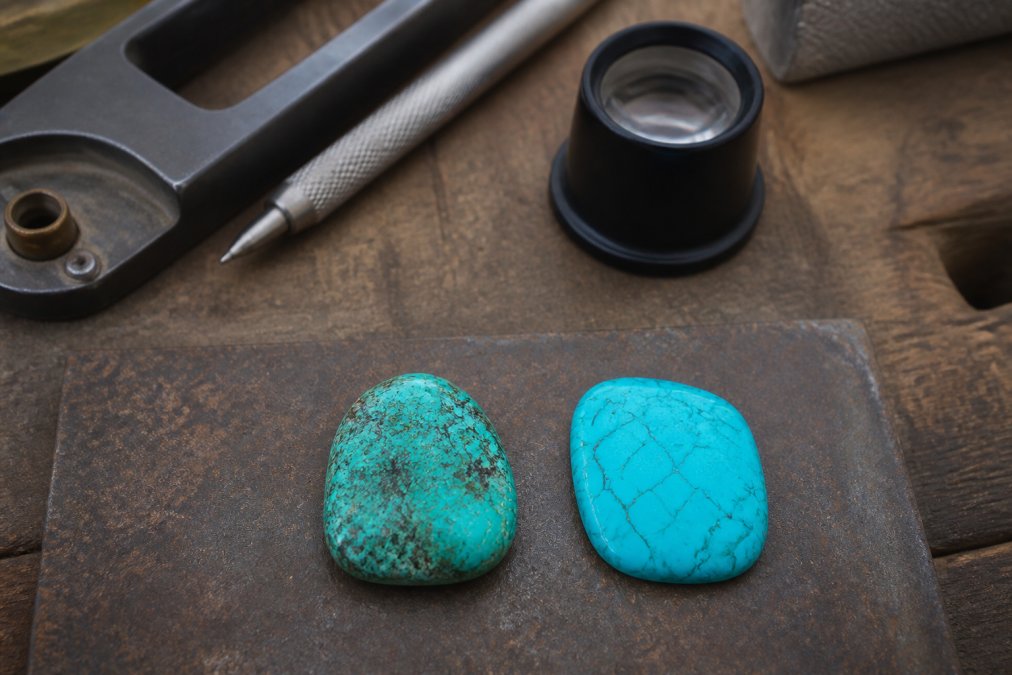
Visual Markers of Authentic vs. Synthetic Turquoise
Natural turquoise has character. It's never perfectly uniform in color. Genuine pieces show irregular veining and matrix patterns, color variation across the stone, a slightly waxy or dull finish, and visible inclusions. Synthetic and treated turquoise appears almost too perfect, with uniform consistent color, plastic-like or overly glossy finish, suspiciously identical patterns across multiple pieces, and artificially enhanced colors.
Some legitimate turquoise is treated to stabilize it or enhance color, that's acceptable and common. What's not acceptable is passing off synthetic material as natural turquoise without disclosure. A reputable seller will state "stabilized natural turquoise" or "natural turquoise with color enhancement" if treatments have been applied.
Understanding Stone Consistency and Color Variation
Real turquoise comes from specific mining regions, each producing stones with distinct characteristics. Sleeping Beauty turquoise from Arizona tends toward bright blue. Kingman turquoise is often more greenish. Bisbee turquoise shows darker matrix. When you see a seller offering dozens of pieces in identical shades, that's a sign of mass production or synthetic material.
Ask the seller about the turquoise's origin. Legitimate artisans know where their materials come from and can tell you the mining region, sourcing year, and whether it's been treated. If the answer is vague, the turquoise probably isn't what they claim.
Identifying Authentic Navajo Jewelry Hallmarks and Silversmithing
Silver work is where craftsmanship truly shows. Hand-forged, hand-stamped silver tells a story that mass production cannot replicate. Learning to read hallmarks and evaluate silversmithing quality is essential to verifying authenticity.
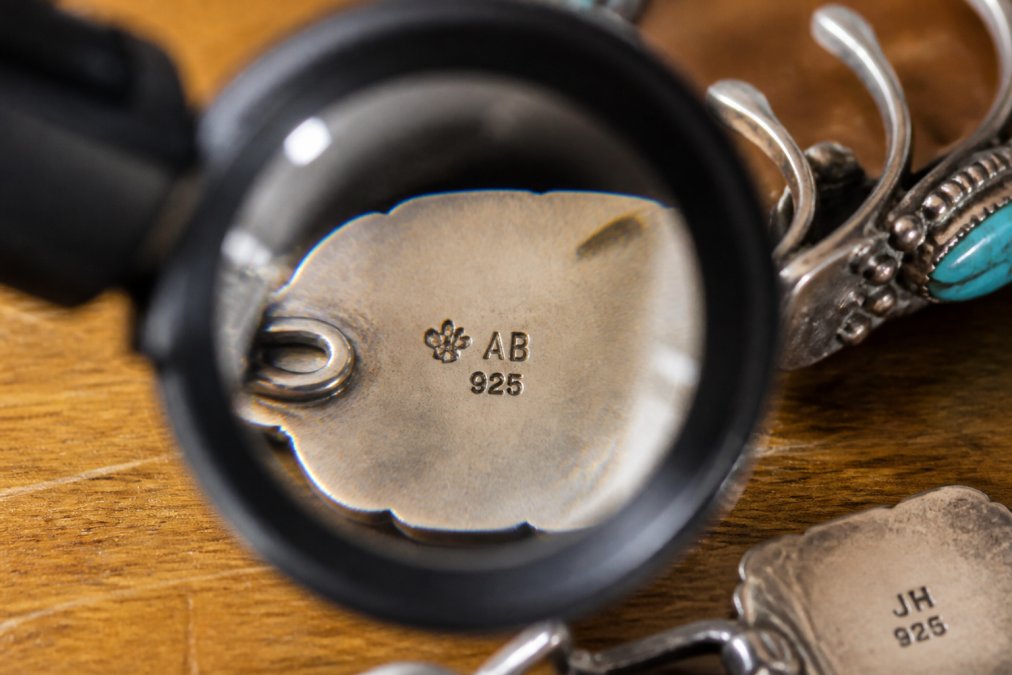
What Legitimate Hallmarks Look Like
Every piece of authentic Native American jewelry should carry hallmarks identifying the artist and confirming silver quality. Look for "Sterling" or "925" (indicating 92.5% pure silver), the artist's initials or signature, and sometimes a tribal symbol or maker's mark. Hand-stamped hallmarks have character, they're not perfectly uniform because they were made by hand, one at a time.
Mass-produced pieces often have hallmarks that are too perfect, too shallow, or applied with a machine press. Compare hallmarks across different pieces from the same seller. If they're identical down to the millimeter, that's a sign of machine production. Legitimate artisans stamp their marks on the back or interior of pieces, where they won't interfere with the design but are still accessible for verification.
Sterling Silver Quality and Hand-Crafted Indicators
Genuine hand-crafted silver shows the marks of its creation: slight irregularities in thickness, evidence of hand-filing and smoothing, visible but neat solder joints, and substantial weight. Mass-produced pieces feel lighter and show signs of casting or stamping from molds. The silver is often thinner, and the work is too uniform.
Run your finger along the inside of a bracelet or the back of a pendant. Does it feel smooth and well-finished, or rough and uneven? Hand-crafted pieces are finished with care. The silversmith knows you'll wear this piece against your skin, so they take time to smooth every edge.
Where to Buy Authentic Native American Jewelry Online
Knowing what to look for is half the battle. The other half is knowing where to shop.
Artist Collectives and Direct-From-Artisan Sources
The most direct path to authenticity is buying from artist collectives or directly from individual artisans. These sellers have the most to lose from fraud and the most to gain from transparency. Many Navajo and Zuni artisans now maintain their own websites or sell through cooperative platforms where multiple verified artists display their work.
Artist collectives typically provide verified artist profiles with enrollment documentation, direct communication channels with makers, detailed provenance for each piece, educational content about techniques and materials, and fair-trade pricing that actually compensates the artisan. When you buy from a collective, you're supporting the artisan directly with no middleman taking a cut.
Reputable Retailers With Verified Provenance
Some online retailers have built their reputation on rigorous sourcing and transparency. These businesses work directly with artisans and maintain detailed provenance records. Turquoise Mustang offers a curated selection of handcrafted Native American and Western-style jewelry, featuring authentic designs from Navajo and Zuni artisans. We also offer our own proprietary lines of Western jewelry. These are all sterling, made with a variety of authentic stones and clearly hallmarked to distinguish our products from Native made jewelry.
When evaluating a retailer, ask whether they can provide the artist's name and tribal enrollment for each piece, if they offer a guarantee of authenticity, whether they're transparent about sourcing, if they have customer reviews mentioning authenticity and quality, and whether they provide a certificate of authenticity with your purchase.
How to Report Fraudulent Native American Jewelry Websites
If you encounter a website misrepresenting mass-produced or counterfeit jewelry as authentic Native American work, you can report it. The Indian Arts and Crafts Board maintains a complaint process for suspected violations. Include the website URL, specific product listings, and what makes you believe they're fraudulent.
You can also report to the Federal Trade Commission for deceptive marketing practices. If a seller is making false claims about authenticity or origin, that's consumer fraud.
Buying authentic Native American jewelry should feel like a privilege, not a gamble. When you know how to verify a seller's legitimacy, checking for Indian Arts and Crafts Act compliance, examining hallmarks and materials, and demanding artist attribution, you eliminate most of the risk. Start with direct sources: artist collectives, verified retailers like Turquoise Mustang, and individual artisans whose work you can trace. When you buy from sources that prioritize transparency, you're not just getting beautiful jewelry, you're supporting the continuation of traditional craftsmanship.
Frequently Asked Questions
Q: How can I verify that a Native American jewelry website is legit?
A: Check for Indian Arts and Crafts Act compliance by looking for clear artist attribution, tribal affiliation, and hallmarks on pieces. Legitimate sellers provide detailed provenance, artist names, and often include certificates of authenticity. Avoid sites with vague descriptions like 'Native-style' instead of 'Native-made.'
Q: What are the main red flags of a fraudulent Native American jewelry website?
A: Red flags include unusually low prices for handcrafted pieces, no artist names or tribal affiliations listed, generic product descriptions, lack of hallmarks or certificates of authenticity, and claims of 'wholesale' pricing on retail sites. Counterfeit sellers often use stock photos, have poor contact information, avoid questions about provenance, and make vague claims about 'authentic' without documentation. If a site doesn't explain its sourcing or artist relationships, it's likely mass-produced or fraudulent.
Q: How can you tell if turquoise jewelry is mass-produced versus authentic?
A: Authentic turquoise shows natural color variation, matrix patterns, and slight irregularities in stone setting. Mass-produced turquoise appears uniformly colored, perfectly smooth, and often has identical pieces repeated across listings. Real hand-crafted pieces have unique inlay work with visible silversmithing variation. Check stone consistency under light, synthetic turquoise often has a plastic-like sheen. Authentic pieces are heavier due to solid sterling silver construction, while mass-produced items feel lighter and may use silver plating over base metals.
Q: What does Indian Arts and Crafts Act compliance mean when buying online?
A: The Indian Arts and Crafts Act is a federal law that makes it illegal to misrepresent Native American art or jewelry. Compliant sellers clearly state whether pieces are created by federally recognized tribal members, provide artist credentials, and use proper terminology, 'Native-made' or 'Navajo-made,' not 'Native-inspired' or 'Native-style.' Online, this means the website should display artist names, tribal affiliations, and hallmarks. Violation of this act is a federal crime, so legitimate sellers take compliance seriously and provide full documentation of authenticity.
Q: How do I identify authentic Navajo jewelry hallmarks?
A: Authentic Navajo hallmarks include the artist's initials or name stamp, 'Sterling' or '.925' marking for silver content, and sometimes tribal affiliation stamps. Hallmarks should be crisp, clearly struck into the metal, and consistent with hand-stamping techniques. Counterfeit hallmarks appear shallow, inconsistent, or poorly aligned. If you're unsure, request documentation of the artist's credentials or contact the artist directly through an artist collective or tribal registry to verify the hallmark's authenticity.
This article was written using GrandRanker