


Best Ways to Style Western Jewelry in 2026
Table of Contents
- What Makes Western Jewelry Worth Styling Around
- How to Layer Western Necklaces Without the Tangle
- Styling Squash Blossom Necklaces for Any Occasion
- Turquoise Jewelry Stack Inspiration: Cuffs, Rings, and More
- Statement Earrings and the Cowgirl Aesthetic
- Mixing Metals, Antique Finishes, and Vintage Pieces
- Western Jewelry Care: Keeping Handcrafted Pieces at Their Best
- Conclusion
Last Updated: August 22, 2026
What Makes Western Jewelry Worth Styling Around
Western jewelry is handcrafted adornment rooted in Navajo, Zuni, and broader Southwest traditions, distinguished by sterling silver construction, natural stones like turquoise and coral, and techniques including stampwork, tufa casting, and mosaic inlay. Each piece carries the fingerprint of the artisan who made it.
A handcrafted turquoise cuff or squash blossom necklace is not simply an accessory, it is a focal point. The best ways to style western jewelry start with understanding that these pieces are built to lead an outfit, not follow it.
At Turquoise Mustang, we work directly with Navajo and Zuni silversmiths whose pieces reflect generations of technique. The collection spans tufa cast cuffs, mosaic inlay rings, repoussé bracelets, and sterling silver pendants, each hallmarked and artisan-attributed. That transparency separates authentic handcrafted jewelry from mass-produced imitations.
The styling principles below apply whether you are building a full western wardrobe or adding a single statement piece to a modern wardrobe.
How to Layer Western Necklaces Without the Tangle
Layering necklaces is one of the most effective western jewelry styling techniques, and also the one most people get wrong. The instinct is to pile on as many pieces as possible, resulting in visual noise and tangling.
Jewelry industry guidance on necklace layering techniques
The 2:1:1 Rule for Necklace Layering
The 2:1:1 rule is a practical framework: two simple chain or pearl strands at different lengths, one pendant piece, and one statement or textured element. This creates depth without competition.
For western jewelry:
- Base layer (16-18 inches): A strand of Navajo pearls or simple sterling chain sits close to the collarbone.
- Mid layer (20-22 inches): A naja pendant or squash blossom pendant drops to mid-chest as the visual anchor.
- Long layer (24-28 inches): A lighter chain or smaller pendant extends below, adding movement.
Keep the longest piece the simplest. If your naja pendant is already complex, the long layer should be a clean chain.
Pairing Pendants With Navajo Pearls
Navajo pearls are hand-stamped sterling silver beads and among the most versatile elements in western jewelry layering. Their uniform texture reads as neutral against almost any pendant.
The Turquoise Naja Pendant with Cast Setting by Dan Dodson pairs cleanly with Navajo pearls because the crescent silhouette contrasts the round bead forms without competing. The turquoise center stone introduces color while the pearls stay silver, keeping the palette cohesive.
A common mistake is pairing two pendants of similar size on adjacent layers. Size contrast, one large, one small, resolves this immediately.
Styling Squash Blossom Necklaces for Any Occasion
The squash blossom necklace is the most iconic form in Navajo jewelry and often misunderstood from a styling perspective. Many treat it as a costume piece reserved for special events. A well-made squash blossom necklace is wearable sculpture, and your job is to get out of its way.
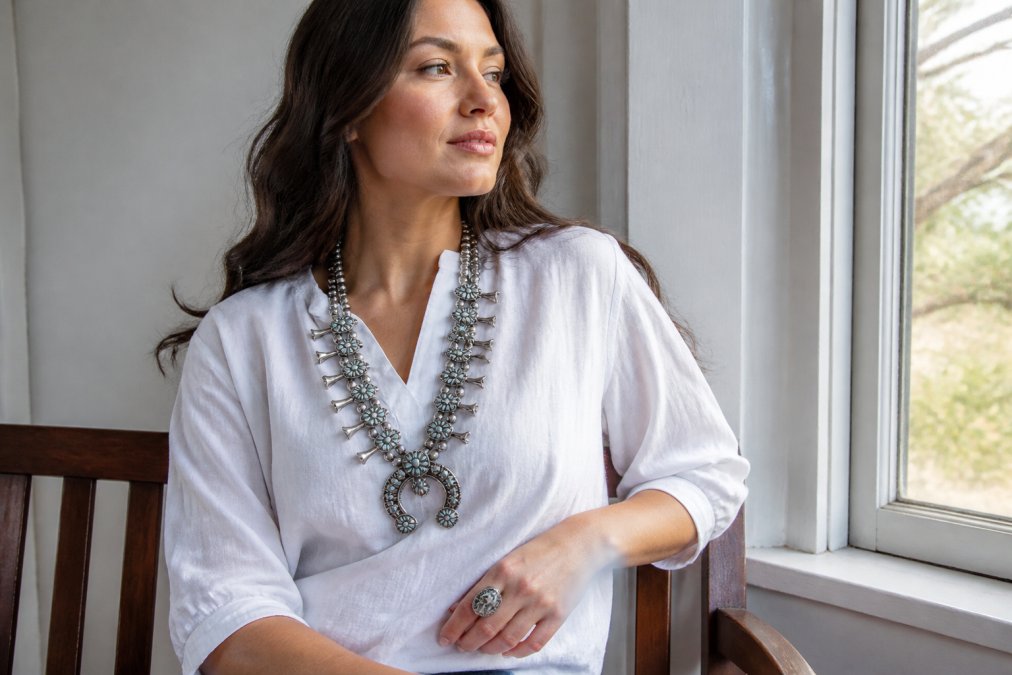
Dressing It Down: Denim and Casual Outfits
The most effective casual pairing is a plain white or cream top in natural fabric, linen, cotton, or lightweight knit, with dark denim. The contrast between structured silver and relaxed fabric is what makes the combination work.
Avoid busy patterns, embellishment, or high necklines. A scoop neck or V-neck gives the necklace room to sit correctly. Tuck the shirt to show the waist and let the necklace define the upper body. Leather boots in tan or cognac echo warm tones without introducing a new color story.
Transitioning From Day to Night
The same squash blossom necklace that reads casual over denim reads formal over a silk slip dress or tailored blazer. For evening, swap denim for a solid-color dress in deep neutral: charcoal, ivory, or rust. Remove any other necklaces and let the squash blossom stand alone. Add simple silver earrings, small posts or understated drops, rather than competing statement earrings.
Turquoise Jewelry Stack Inspiration: Cuffs, Rings, and More
A turquoise jewelry stack is built on contrast: weight, texture, stone color, and silverwork pattern. The mistake most people make is stacking pieces that are too similar, producing a flat, repetitive look rather than layered depth.
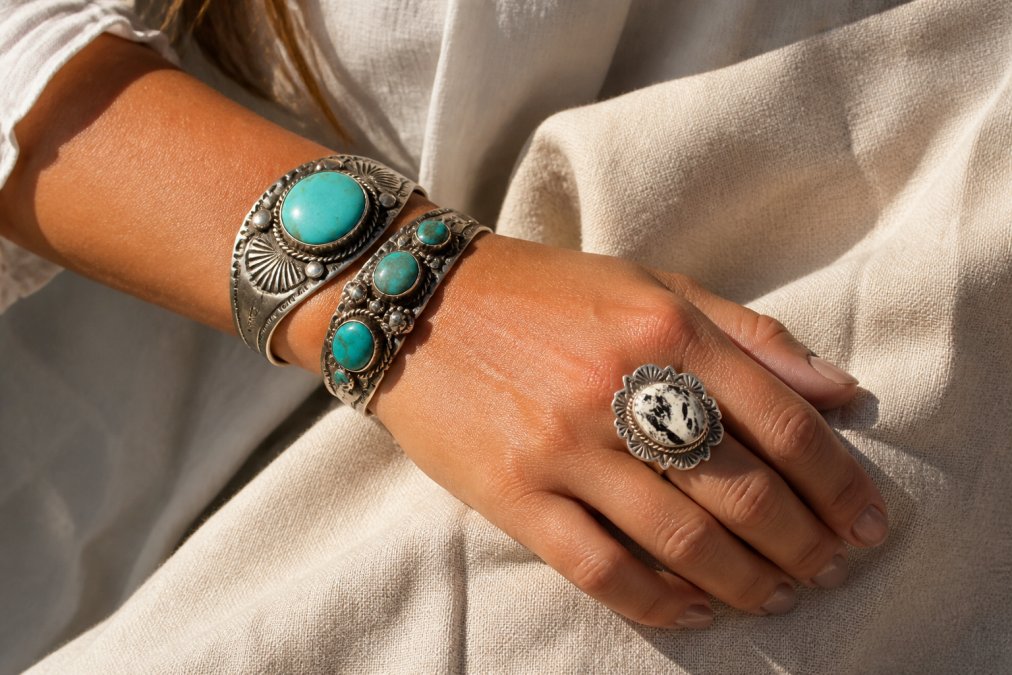
Stacking Cuffs by Weight and Texture
Start with the heaviest, most detailed cuff as the anchor. The Red Coral and Spiny Oyster Repoussé Cuff by Darryl Becenti anchors a stack immediately with its repoussé flame forms and dense stampwork. Pair it with a lighter, plainer cuff on the same wrist for balance, such as the Thunderbird/Crosses Overlay Bracelet by Darrell Cadman, whose all-silver overlay design provides textural contrast without color competition.
The stacking order matters:
- Place the widest, heaviest cuff closest to the wrist bone.
- Add a medium-weight piece above it.
- Finish with the lightest or most linear piece at the top.
For rings, mix stone types and cut shapes. The Birdseye Kingman Turquoise Ring by Calvin Martinez features a large oval cabochon with geometric stampwork. Pair it with the White Buffalo Oval Ring by M. Spencer, whose high-contrast black-and-white matrix reads as visually neutral next to blue-green Kingman stone.


Body Type and Jewelry Proportions
The scale of a piece should relate to your frame. Wider, heavier cuffs spanning 2 inches or more read best on longer arms and larger wrists. On a smaller frame, a wide cuff can overwhelm the wrist. A narrower, more refined cuff achieves the same western aesthetic without proportion problems.
For necklaces, the same logic applies. A full squash blossom necklace suits a broader shoulder line. On a narrower frame, a single naja pendant on a chain delivers the same aesthetic with better proportion.
Statement rings are the most forgiving category for body type. A bold oval cabochon reads well on almost any hand.
Statement Earrings and the Cowgirl Aesthetic
Statement earrings are the fastest way to introduce the cowgirl aesthetic into a modern wardrobe. A single pair of drop earrings in sterling silver and natural stone can shift the entire register of an outfit.
The Navajo Pearl & Spiny Oyster Drops by Sophia Becenti exemplify this. The combination of classic Navajo pearl forms with vibrant purple and orange spiny oyster shell creates a drop earring that is unmistakably western yet bold enough for contemporary fashion.

When earrings are the statement, keep everything else quiet. A plain crew-neck sweater, white button-down, or simple dress gives drop earrings the space they need. Add a cuff on one wrist if you want to extend the western accessory story, but resist layering necklaces simultaneously.
For the cowgirl aesthetic, pair high-contrast earrings against a monochromatic outfit. Warm spiny oyster tones against cream or off-white, or silver and turquoise against deep navy, create visual clarity that reads as intentional.
Mixing Metals, Antique Finishes, and Vintage Pieces
Most styling guides tell you to stick to one metal. For western jewelry, that advice is incomplete.
Sterling silver is the foundation of the western jewelry tradition, but antique finishes, oxidized silver, and mixed-stone pieces introduce enough variation that strict metal matching becomes unnecessary. Match the finish rather than the metal.
Oxidized or darkened silver has a warm, antique quality that pairs naturally with aged leather, worn denim, and natural fabrics. Bright-polished sterling reads more contemporary and suits cleaner, modern outfits. Mixing oxidized and polished pieces in the same stack creates visual tension that can work if the pieces share a common stone palette or silverwork style.
Vintage and antique pieces integrate well into a modern western look when treated as the anchor rather than the accent. A vintage pawn-quality cuff from the 1940s or 1950s carries enough presence to define an entire outfit. Build around it with simpler, contemporary pieces that do not compete with its patina.
Turquoise Mustang offers a curated selection of handcrafted Native American and Western-style jewelry, featuring authentic designs from Navajo and Zuni artisans. Our collection includes high-quality turquoise cuffs, Mustang Silver Pearls, and unique squash blossom necklaces that celebrate traditional craftsmanship. Discover the beauty of heritage-inspired accessories that combine unbeatable craftsmanship with a distinct Western aesthetic.
Smithsonian's overview of Navajo silversmithing history and techniques
Western Jewelry Care: Keeping Handcrafted Pieces at Their Best
Handcrafted sterling silver western jewelry requires straightforward but consistent care to protect your investment.
Tarnish prevention: Sterling silver tarnishes through oxidation, accelerated by humidity, skin oils, and contact with chemicals including perfume, lotion, and household cleaners. Remove jewelry before applying any product to your skin, and put pieces on last when getting dressed.
Storage: Store individual pieces in anti-tarnish pouches or a lined jewelry box with separate compartments. Cuffs and heavy pieces should not be stacked on top of each other, as weight and contact can scratch silverwork and damage stone settings.
Cleaning: For light tarnish, use a soft polishing cloth designed for sterling silver. For heavier tarnish on stamped or textured pieces, use a soft-bristle toothbrush with mild dish soap and warm water. Rinse thoroughly and dry completely before storing.
Stone care: Turquoise is porous and should never be submerged in water or exposed to ultrasonic cleaners. The same applies to coral, spiny oyster shell, and other organic materials. Wipe stones gently with a dry or barely damp cloth.
Cuff adjustment: Sterling silver cuffs can be gently adjusted for fit, but repeated bending in the same spot weakens the metal. For significant resizing, consult a professional silversmith.
According to the Gemological Institute of America's guidance on turquoise care, turquoise is particularly vulnerable to oils and cleaning chemicals, which can alter its color permanently. This is especially relevant for high-quality stones like Carico Lake and Number Eight turquoise, where color is a primary part of value.
The Number Eight Turquoise Tufa Cast Cuff by Roland Dixson features Number Eight turquoise from a mine that ceased production in the 1970s. Genuine Number Eight material is increasingly rare, making proper care a preservation responsibility.
Styling Summary: Western Jewelry at a Glance
| Styling Goal | Key Technique | What to Avoid |
|---|---|---|
| Layering necklaces | 2:1:1 rule: pearls, pendant, accent | Two pendants of equal size |
| Squash blossom necklace | Plain neckline, solid neutral top | Busy patterns or high collars |
| Turquoise cuff stack | Anchor heavy, layer lighter above | Matching pieces with identical texture |
| Statement earrings | Monochromatic outfit as backdrop | Pairing with squash blossom simultaneously |
| Mixing antique and modern | Match finish temperature, not metal type | Oxidized and polished silver in equal weight |
| Ring stacking | Contrast stone colors and cut shapes | Same stone type on adjacent fingers |
Western jewelry styling comes down to one principle: let the craftsmanship lead. These are objects designed to define an outfit, not complement one.
Turquoise Mustang offers a curated selection of handcrafted Native American and Western-style jewelry, featuring authentic designs from Navajo and Zuni artisans. Our collection includes high-quality turquoise cuffs, Mustang Silver Pearls, and unique squash blossom necklaces that celebrate traditional craftsmanship. Discover the beauty of heritage-inspired accessories that combine unbeatable craftsmanship with a distinct Western aesthetic. Browse the full selection to find pieces worth styling around.
Frequently Asked Questions
Q: How do you layer western necklaces without them tangling?
A: Length separation is the most reliable method. Choose necklaces that differ by at least 5 centimeters in length, for example, a 16-inch choker, an 18-inch pendant, and a 22-inch Navajo pearl strand. Heavier chains and beaded strands sit best closest to the body. Avoid mixing chains with similar link styles, since identical textures catch on each other. A lobster-claw extender on one necklace lets you fine-tune spacing on the fly.
Q: What is the best way to stack turquoise cuffs?
A: Start with one wide statement cuff, a tufa cast or repoussé piece, as the anchor, then add narrower all-silver or overlay cuffs on either side. Vary the finish: a matte tufa cast next to a polished stampwork cuff creates contrast without clashing. Keep the turquoise cuff centered on the wrist and let silver-only pieces flank it. Three cuffs total is the practical maximum before the stack becomes uncomfortable and the individual craftsmanship gets lost.
Q: What jewelry do cowgirls wear, and how has the style evolved?
A: Classic cowgirl jewelry centers on turquoise, silver cuffs, concho belts, and squash blossom necklaces, all rooted in Navajo and Zuni silversmithing traditions. Modern western fashion has expanded that palette to include spiny oyster shell, coral, and white buffalo stone alongside the traditional turquoise. The current trend leans toward mixing handcrafted statement pieces with minimalist modern clothing, letting one bold western jewelry piece anchor an otherwise simple outfit rather than stacking every traditional element at once.
Q: How can I incorporate western jewelry into a professional wardrobe?
A: Single-stone rings and understated silver cuffs translate best into professional settings. A Navajo pearl strand worn alone reads as polished rather than costume. Avoid layering multiple statement pieces for office wear, choose one focal piece and keep everything else minimal. An all-silver squash blossom pendant on a clean chain over a blazer is a strong professional look. Sterling hallmarked pieces with clean lines work especially well because the craftsmanship reads as fine jewelry rather than fashion accessory.
This article was written using GrandRanker