


Is Handmade Silver Jewelry Worth the Price? A 2026 Guide
Table of Contents
- What Makes Handmade Silver Jewelry Different?
- The Value of Sterling Silver Jewelry: Metal vs. Artistry
- How to Identify Authentic Handmade Silver Jewelry
- Why Handmade Costs More Than Mass-Produced
- Does Handmade Silver Hold Its Value Over Time?
- Spotting the Best Heirloom Quality Turquoise Jewelry Brands
- Is It Worth It for You? A Buyer's Checklist
- The Bottom Line
- Frequently Asked Questions
Last Updated: September 9, 2026
When you hold a handmade silver cuff next to a mass-produced lookalike, the difference is immediate: weight, texture, and a sense of intention that machine casting rarely captures. At Turquoise Mustang, we curate collections from Navajo and Zuni artisans, and we often hear buyers ask why a single cuff costs more than an entire rack of stamped imports. Handmade silver jewelry is a category where materials tell only part of the story; the labor, skill, and heritage embedded in each piece carry the rest. Below, we break down exactly what you are paying for, how to verify authenticity, and whether the investment makes sense for your collection.
What Makes Handmade Silver Jewelry Different?
The core distinction is fabrication method. Handmade silver jewelry is constructed piece by piece from sheet metal, wire, and ingots, shaped through sawing, soldering, forging, and stamping by a silversmith's hand. Mass-produced pieces are typically cast in molds or stamped out by machines, allowing identical output at scale.
The Process: Casting vs. Hand Fabrication
Casting reproduces the same design repeatedly with minimal labor per unit. Hand fabrication requires a silversmith to cut, form, and join each component individually; a single hand-stamped cuff can take several hours of concentrated work, and finishing adds more time. That labor-intensive process is the primary reason prices diverge so sharply from commercial alternatives.
The Value of Sterling Silver Jewelry: Metal vs. Artistry
Sterling silver is 92.5 percent pure silver alloyed with copper for strength, and its intrinsic value is a matter of public record (the FTC). The precious metal content of a typical cuff represents a modest baseline, often a fraction of the retail price. The real value of sterling silver jewelry in the handmade category lies in artistry: the composition, the stone setting, the depth of stampwork, and the cultural narrative the piece carries.
Consider a tufa cast cuff with a large freeform turquoise cabochon. The casting method, which uses volcanic tuff as a mold, produces one-of-a-kind texture that cannot be replicated. You are paying for the artisan's eye and the hours of risk inherent in working with natural materials that can crack or shift mid-process.
How to Identify Authentic Handmade Silver Jewelry
Authenticating handmade work requires looking beyond the price tag. A common mistake is assuming a 925 stamp alone proves hand fabrication; it only confirms the alloy. True handmade pieces show evidence of human hands in ways that are learnable with practice.
Reading Hallmarks and Stamps
Look for a hallmark indicating silver purity, such as "925" or "Sterling." Many Native American artisans also stamp their name, a tribal designation, or a hallmark symbol. The United States Federal Trade Commission guidelines on jewelry labeling address misrepresentation in precious metal content, but they do not govern "handmade" claims, so buyer vigilance matters. A signature stamp is a strong signal, though its absence does not automatically disqualify a piece, as some artisans work unsigned.
Visual Cues: Tool Marks and Symmetry
Inspect the surface under good light. Hand-stamped designs show slight variations in depth and spacing between impressions, while machine stamping is unnervingly uniform. Look at the edges of a cuff: hand-fabricated pieces often retain subtle asymmetry and file marks that polishing softens but rarely erases. The back of a handmade piece is typically finished with the same care as the front.
The Flaw Checklist: What Quality Artisans Never Leave Behind
When you examine a piece, look specifically for these flaws that indicate poor soldering or rushed casting:
-
Solder seams. On a quality handmade piece, solder joints are invisible or appear as a clean, thin line. Poor work shows blobs of excess solder, gaps, or discoloration where the joint meets the silver. Run your fingernail across any joint, it should feel smooth, not bumpy.
-
Pitting and porosity. Cast pieces, especially tufa casts, can develop tiny holes or rough pits on the surface. A skilled artisan fills and polishes these out. If you see a constellation of small pits, especially on the front of the piece, the finishing work was rushed.
-
Stone setting edges. A properly set cabochon has a bezel that hugs the stone evenly with no gaps. Run your finger around the stone, the bezel should feel uniform. If you can see light between the stone and the bezel, or if the metal looks wavy or uneven, the setting is insecure and the stone may loosen over time.
-
Stamp depth and consistency. Hand-stamped designs should have clear, deep impressions. Shallow or uneven stamps that fade at one end suggest the artisan did not strike with consistent force, which can also mean the piece was not properly annealed (softened) before stamping, leading to cracks later.
-
Cracks at stress points. Check the inside curve of a cuff and the area where the shank meets the head of a ring. These are stress points where poor soldering or over-hammering causes micro-cracks. A jeweler's loupe (10x magnification) reveals these clearly; they are a dealbreaker because they will worsen with wear.
The Magnet and Ice Tests: Quick Checks That Work
Two simple field tests help verify the metal itself. First, sterling silver is non-magnetic, a strong neodymium magnet should not stick to the piece (test the main body, not the clasp, as some clasps contain steel springs). Second, silver has the highest thermal conductivity of any common metal: place an ice cube on the piece, if it melts rapidly, that is consistent with solid silver rather than silver-plated base metal (en.wikipedia.org). These tests confirm the alloy, not the craftsmanship, so pair them with the visual checklist above.
The Provenance Interview
Finally, the most reliable identifier is the seller. Ask direct questions: Who made this? Can you name the silversmith? What is their hallmark? Where was the turquoise mined? A legitimate curator answers without hesitation. Vague responses like "we source from the Southwest" or "it's from a Navajo family" without a name are warning signs. The best sources, like Turquoise Mustang, document the artisan and distinguish clearly between Native-made pieces and their own proprietary Western jewelry lines, which are hallmarked to prevent confusion.
Why Handmade Costs More Than Mass-Produced
The economics are straightforward: time, skill, and materials. A Navajo silversmith may spend four to six hours on a single stamped cuff, and mastery of the craft takes years of apprenticeship. Mass-produced alternatives are pressed out in seconds by machines. Add the cost of high-grade turquoise, which is mined and cut with its own labor chain, and the price gap becomes logical rather than arbitrary.
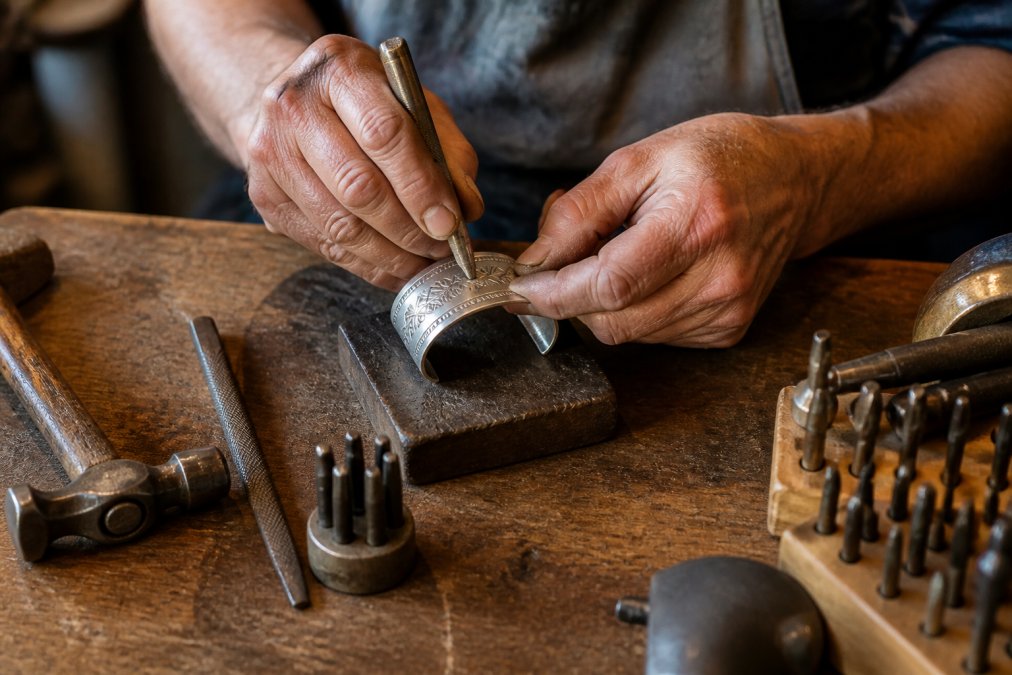
What most guides miss is the rejection rate. Artisans discard pieces with cracks, mis-struck stamps, or stone-setting errors. That waste is built into the price of the pieces that succeed.
Does Handmade Silver Hold Its Value Over Time?
Unlike machine-made fashion jewelry, which depreciates quickly, well-crafted handmade pieces tend to retain meaningful value. But "holding value" is a split between two very different components: the commodity value of the silver and the artistic premium of the work.
Commodity Value vs. Artistic Premium
Every piece of sterling silver has a floor price: the melt value of the metal. As of this writing, silver trades in a range that makes the raw metal in a typical 30-gram cuff worth roughly $20 to $30. That is your commodity value, it fluctuates daily with the market and is the same whether the cuff is a factory stamping or a masterpiece by a renowned silversmith.
The artistic premium is everything above melt value. It reflects the maker's reputation, the quality of the stone, the complexity of the work, and the cultural significance of the piece. For a signed cuff by a recognized Navajo or Zuni artist, the artistic premium can be 10 to 50 times the commodity value. For unsigned or anonymous work, the premium shrinks dramatically, often to near zero on the resale market.
How the Resale Market Actually Works
The resale market for vintage and antique Native American jewelry is active but specialized. The main channels are:
- Auction houses that specialize in Native American art (such as those in Santa Fe and Scottsdale), these command the highest prices for documented pieces by known artists but take significant commissions and require provenance paperwork.
- Specialist dealers and galleries who buy collections outright, they typically pay 30 to 50 percent of what they expect to retail the piece for, which means you need a piece with strong documented value to make this worthwhile.
- Online marketplaces, these reach the widest audience but are flooded with mass-produced lookalikes, making it hard for a buyer to verify authenticity without handling the piece. Signed work with clear hallmarks and photographs of the maker's mark performs best here.
A signed cuff by a recognized silversmith can appreciate, particularly if the artist's reputation grows or their output diminishes. But an unsigned piece, no matter how beautiful, will struggle to recoup its original retail price on the secondary market. The signature is the single strongest driver of resale value.
The Tarnish Question: Maintenance and Value
Tarnish is a maintenance consideration, not a value threat. Sterling silver darkens with exposure to air and sulfur compounds, but polishing restores the original finish. Storing pieces in anti-tarnish cloths and avoiding harsh chemicals preserves both appearance and resale appeal. However, deep scratches, bent shanks, and worn stampwork do reduce value, these require professional repair and signal heavy wear to a prospective buyer.
The Heirloom Math
For most buyers, the real return on a handmade piece is not financial, it is the cost per wear over decades. A $400 handmade cuff worn 200 times a year for 20 years costs about 10 cents per wear. A $40 mass-produced cuff that breaks or tarnishes irreparably in two years costs about 50 cents per wear and ends up in a landfill. The handmade piece also carries the possibility of appreciation if the artist's reputation grows; the mass-produced piece carries none.
For collectors and gift-givers, the wisest approach is to buy what you love from a source that documents the maker. That way, whether the piece appreciates or simply serves you faithfully for decades, the value is realized either way.
Spotting the Best Heirloom Quality Turquoise Jewelry Brands
Discerning buyers seeking heirloom quality turquoise jewelry brands should prioritize provenance and transparency. The best brands document who made each piece, name the artisan, and provide verifiable hallmarks. They distinguish clearly between Native-made work and their own proprietary lines, as Turquoise Mustang does with clear hallmarks on its Western jewelry collections.
A reputable source will tell you the silversmith's name, the tribal affiliation, and the turquoise mine when known. Ask direct questions: Who made this? What is the hallmark? Can you share the artist's story? The answers separate genuine curators from mere resellers.
Is It Worth It for You? A Buyer's Checklist
Use this framework to decide whether handmade silver jewelry fits your goals:
- Confirm your purpose. Are you buying for daily wear, heirloom gifting, or collection building? Each goal justifies different spending.
- Verify the maker. Seek named artisans with documented hallmarks and a traceable history.
- Assess the stone. Natural turquoise with stable matrix and vivid color commands a premium over treated or stabilized material.
- Examine the construction. Check for even stampwork, secure stone settings, and finished backs.
- Consider the resale angle. Signed pieces from recognized artists hold value better than unsigned work.
- Match the piece to your style. A substantial cuff can anchor a minimalist wardrobe if you commit to wearing it as a statement.
| Consideration | Handmade Piece | Mass-Produced Piece |
|---|---|---|
| Fabrication | Hand-cut, soldered, stamped | Mold-cast or machine-stamped |
| Uniqueness | One of a kind | Identical to others |
| Artisan provenance | Named and documented | Anonymous |
| Labor per piece | Hours of skilled work | Seconds of machine time |
| Resale potential | Strong for signed work | Minimal |
| Price | Higher, justified | Lower, commodity-based |
The Bottom Line
Handmade silver jewelry is worth the price when authenticity, craftsmanship, and longevity matter to you. The value of sterling silver jewelry extends beyond the metal itself into the artistry, cultural heritage, and heirloom potential that mass production cannot replicate. For collectors and gift-givers seeking pieces with a story, the premium is an investment in quality that outlasts trends. Turquoise Mustang offers handcrafted Native American and Western jewelry with named artisans, clear hallmarks, and exclusive wholesale access, built for those who value pieces that carry meaning. Start your search with confidence, and choose work that speaks to you and will speak for generations.
Frequently Asked Questions
Does handmade silver jewelry hold its value over time?
Yes, particularly when it comes from recognized artisans or represents high-quality craftsmanship. The intrinsic value of the sterling silver provides a baseline, but the artistry and reputation of the maker can increase its resale value. Mass-produced pieces typically depreciate, while a well-made handmade piece from a known artist can retain or even grow in value, especially if the artist gains recognition.
Is handmade jewelry more expensive than mass-produced?
Generally, yes. The price difference reflects the labor-intensive process. A handmade piece involves hours of sawing, soldering, stamping, and finishing by a skilled artisan. Mass-produced jewelry is cast in molds or stamped out by machines in minutes, which significantly lowers production costs. You are paying for the skill, time, and uniqueness that comes with a handcrafted item.
How can you distinguish between mass-produced and handmade silver jewelry?
Look for slight irregularities that indicate human hands. Handmade pieces often show subtle tool marks, variations in stamping depth, or a slight asymmetry. Mass-produced items are perfectly uniform. Also, check the finish; handmade jewelry may have a softer polish, while machine-made pieces often have a bright, uniform shine. A maker's hallmark is another strong indicator of handcrafted work.
What should I look for when buying authentic Native American silver jewelry?
Look for a hallmark from the specific artist or a recognized tribe. This is your proof of authenticity. Also, examine the quality of the silver, which should be stamped '925' for sterling. Study the stonework and stamping for precision and consistency. Buying from reputable dealers who work directly with artisans, like Turquoise Mustang, provides more assurance of a piece's provenance.