


How to Style Sterling Silver Pearl Bracelets
Table of Contents
- What You'll Need Before You Start Styling
- How to Style Sterling Silver Pearl Bracelets for Everyday Elegance
- Stacking Sterling Silver Bracelets with Pearl Cuffs and Bangles
- Best Artisan Sterling Silver Western Cuffs for Pearl Styling
- How to Clean Sterling Silver Pearl Jewelry Without Damage
- Transitioning Pearl Bracelets from Day to Night
- Common Mistakes to Avoid When Styling Pearl Bracelets
- Conclusion
- Frequently Asked Questions
Last Updated: September 10, 2026
What You'll Need Before You Start Styling
Styling sterling silver pearl bracelets starts with three things: a clean bracelet, a wrist measurement, and a plan for what you're wearing. Sterling silver pearl bracelets combine the cool brightness of .925 silver with the soft, organic sheen of freshwater pearls, and the pairing works because the two materials play off each other rather than compete.

This combination is often seen in cuffs and bangles where pearls are set directly into hand-stamped silver, which changes how you style them compared with a plain chain bracelet. Gather these before you begin:
- A soft measuring tape or a strip of paper and a ruler
- A dry, lint-free polishing cloth
- A small pouch for storage between wears
- Two or three outfit options so you can test combinations at once
Knowing your wrist measurement matters more than most styling guides admit. A cuff that sits too loose slides over the hand; one that's too tight leaves marks and stresses the silver at the opening.
How to Style Sterling Silver Pearl Bracelets for Everyday Elegance
Everyday elegance with sterling silver pearl bracelets comes down to restraint: one pearl piece, one supporting bracelet, and clothing that lets the silver read clearly. The mistake most people make is treating pearls as formal-only jewelry, then wondering why the bracelet sits in a drawer nine days out of ten.

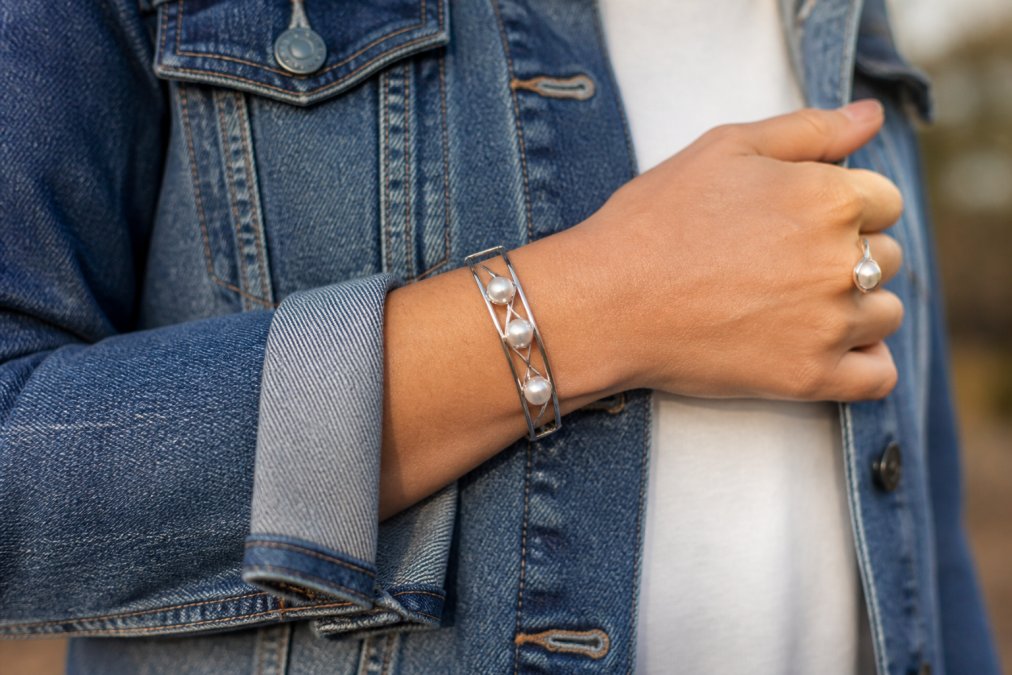
Pearls read as casual when the surrounding outfit is casual. A cuff with small round pearls, worn against a rolled denim sleeve, looks intentional rather than dressy. The silver does the work of keeping the look contemporary; the pearls add texture without adding formality.
Pairing Pearls with Denim and T-Shirts
Denim and a plain tee are the fastest way to make pearl jewelry look modern. The contrast between a rough indigo weave and a smooth, lustrous pearl is what makes the combination work, and it's a pairing that reads as casual chic rather than costume.
Keep the rest of your jewelry minimal when you style this way. One pearl cuff on the dominant hand, nothing on the other wrist, and small studs or nothing at all at the ears. A minimalist aesthetic lets the pearl and silver carry the outfit instead of competing with it.
Choosing the Right Pearl Size for Your Wrist
Smaller pearls suit smaller wrists; larger pearls give a bolder read on any wrist. As a working rule, pearls under about 6 millimeters keep a bracelet looking delicate and stackable, while pearls above 8 millimeters turn the piece into a statement.
Pearl size also changes how the bracelet sits. A row of many small pearls follows the curve of the wrist closely, while a few large pearls create gaps against the skin that catch light and draw the eye.
Stacking Sterling Silver Bracelets with Pearl Cuffs and Bangles
Stacking sterling silver bracelets works best when you vary scale rather than repeat it: one pearl piece, one plain silver piece, and one textured or stone-set piece. Three is usually the ceiling before a stack starts to look cluttered and before metal begins rubbing against metal.

Build the stack from the wrist up. Put the widest or heaviest piece closest to the hand, then layer lighter bangles above it so they can move without dragging. If you're stacking a cuff with bangles, wear the cuff alone on that wrist and move the bangles to the other arm, bangles will slide under and over a cuff, scratching the silver and stressing the cuff's opening.
Match the Metal to Your Skin Tone Before You Stack
Most stacking guides skip this, but sterling silver reads differently depending on your undertone, and that changes which pearls you should pair with it.
- Cool undertones (pink, red, or blue cast in the veins at your wrist): sterling silver looks sharp and bright against the skin, and white or silver-white pearls reinforce that cool cast. This is the easiest pairing to get right.
- Warm undertones (green or olive cast in the veins): sterling silver can look slightly stark on its own, so cream or golden-toned pearls soften the contrast. If you want to mix in a warm metal, keep it to one accent piece rather than splitting the wrist evenly.
- Neutral undertones: you can wear either pearl color, but the silver should stay the dominant metal so the stack has a clear anchor.
A quick test: hold a white pearl and a cream pearl against your bare wrist in daylight. The one that makes your skin look even rather than washed out is your base pearl color.
Clasp Types Change How a Stack Behaves
Clasp choice affects stackability more than most people expect, because a clasp that opens under movement takes the whole stack with it.
| Clasp Type | Security | Ease of Use | Stackability |
|---|---|---|---|
| Lobster claw | High | Easy one-handed | Best for heavier bracelets that anchor a stack |
| Spring ring | Moderate | Fiddly on your own wrist | Catches on fabric and on neighboring bracelets, avoid in a stack |
| Box or snap | High | Moderate | Good for finer bracelets worn closest to the hand |
| Toggle | Moderate | Easy | Can slip if the ring is larger than the bar, size matters |
| No clasp (cuff or bangle) | Highest | Slip-on | The most secure stack anchor because there's nothing to open |
If you take a bracelet on and off daily, lobster claw is the practical choice. Spring rings catch on fabric and on adjacent bracelets and are the most common cause of a bracelet being lost from a stack. Cuffs and bangles have no clasp at all, which is why they hold a stack in place and why they must be sized correctly.
Mixing Metals: Sterling Silver and Pearl Combinations
Mixing metals with pearls is easier than most advice suggests, because pearls are neutral. A pearl's color sits between white, cream, and gray, so it bridges warm and cool tones rather than clashing with either.
The practical version: keep silver as the dominant metal, then add one warm-toned accent, such as a single brass or gold-filled ring, rather than splitting the wrist 50/50. Let the pearl do the bridging work.
Best Artisan Sterling Silver Western Cuffs for Pearl Styling
Artisan sterling silver western cuffs are the strongest foundation for pearl styling because the silverwork gives the pearls a setting with real presence. Hand-stamped ingot construction, common in Southwest silversmithing, produces a denser, heavier cuff than cast silver, and that weight keeps a pearl row sitting flat against the wrist instead of rolling.
Three shapes cover most styling needs:
- A cuff with a full row of small pearls for stacking and everyday wear
- A mid-scale cuff with fewer, larger pearls for a statement look
- A hammered bangle with pearl accents for a lighter, more contemporary feel
Turquoise Mustang carries this range directly. The Freshwater Pearl 13-Stone Sterling Silver Cuff by Dan Dodson sets 13 small round freshwater pearls in a hand-stamped sterling silver cuff, which makes it the natural pick for a first pearl piece or for stacking. For something with more visual weight, the Silver Pearl 11-Stone Ingot Cuff by Dan Dodson uses 11 medium silver-sheen pearls in the same ingot-style construction, and the mid-scale pearl size sits between the smaller 13-stone and larger statement pieces.
If you want a lighter profile, the Hammered Sterling Silver Bangle with Pearl or Onyx Accents offers a dimpled surface finish with raised stone settings in freshwater pearl rounds, black onyx, or lapis. And for a stackable everyday option, the Freshwater Pearl Infinity Bangle strings 33 petite freshwater pearls in an infinity arrangement on sterling silver.
A note on authenticity: our own proprietary Western jewelry lines are sterling, made with a variety of authentic stones, and clearly hallmarked to distinguish our products from Native made jewelry. If you're buying handcrafted Native American work, ask the seller which artisan made the piece and how the attribution is documented.
How to Clean Sterling Silver Pearl Jewelry Without Damage
Cleaning sterling silver pearl jewelry requires keeping the two materials apart during the process, because the cleaners that work on silver will damage pearl. Silver dips, tarnish-remover liquids, and abrasive polishes strip the nacre, the thin outer layer that gives a pearl its luster (gia.edu). Once nacre is gone, it does not come back.
Here's the sequence that works:
- Wipe the pearls with a soft, damp cloth and mild soap, then dry immediately.
- Clean the silver separately with a silver polishing cloth, working around the pearl settings rather than over them.
- Skip ultrasonic cleaners entirely. Vibration and heat damage pearl (gia.edu).
- Store the bracelet in a soft pouch, away from other jewelry that could scratch the silver.
Bracelet Clasp Types and Functionality
Clasp choice affects how a bracelet wears more than most people expect. A cuff has no clasp at all, which is why it holds a stack in place and why it must be sized correctly. Bangles slip over the hand and rely on a continuous ring, so they need enough diameter to clear the widest part of your hand, not just your wrist.
For bracelets with clasps, three types dominate:
| Clasp Type | Security | Ease of Use | Best For |
|---|---|---|---|
| Lobster claw | High | Easy one-handed | Everyday wear, heavier bracelets |
| Spring ring | Moderate | Fiddly on your own wrist | Lightweight chains |
| Box or snap | High | Moderate | Finer bracelets, dressier looks |
If you take a bracelet on and off daily, lobster claw is the practical choice. Spring rings catch on fabric and are the most common cause of a bracelet being lost.
Transitioning Pearl Bracelets from Day to Night
Moving a pearl bracelet from day to night is mostly a matter of what you remove, not what you add. The bracelet that worked with a denim jacket and tee still works at dinner; the change comes from simplifying everything around it.
Swap the canvas tote for a structured bag, trade sneakers for a heel or a clean flat, and cut the stack down to the single pearl piece. If you're wearing a minimalist aesthetic by day, the same bracelet reads as refined against a silk blouse or a simple dress. For formal attire, one pearl cuff on a bare wrist outperforms three bracelets competing for attention.
The reverse also holds. A bracelet that feels too dressy for daytime usually just needs a rougher fabric next to it, such as denim, linen, or a chunky knit.
Common Mistakes to Avoid When Styling Pearl Bracelets
Four mistakes account for most pearl bracelet styling problems, and each has a straightforward fix.
- Wearing pearls with silver dip. The cleaner destroys nacre. Clean the two materials separately, always.
- Stacking a cuff with bangles on the same wrist. The bangles will slide under and over the cuff, scratching the silver and stressing the cuff's opening.
- Ignoring wrist size when buying. A cuff that's too large rotates and catches; one that's too small leaves marks. Measure before you buy.
- Treating pearls as evening-only. This is the mistake that keeps good jewelry in a box. Pearls work with denim, and the contrast is the point.
Jewelry maintenance is not complicated, but it is specific. Silver wants polishing and dry storage. Pearl wants a soft cloth and no chemicals. Keep those two routines separate and both materials will hold up for decades.
Conclusion
The hardest part of styling sterling silver pearl bracelets isn't finding the right piece, it's trusting that a pearl bracelet belongs in your everyday rotation rather than a special-occasion box. Start with one cuff sized to your wrist, wear it against denim for a week, and let the contrast do the work.
Turquoise Mustang curates handcrafted Native American and Western-style jewelry, including sterling silver cuffs and bangles set with freshwater pearls from collaborating Southwest designers like Dan Dodson. Each piece is built for daily wear, and our own proprietary Western lines are sterling, set with authentic stones, and clearly hallmarked. Browse the collection and search for the pearl cuff that fits your wrist and your wardrobe.
Frequently Asked Questions
Are pearl bracelets still in style?
Pearl bracelets remain a timeless choice in 2026. Freshwater pearls paired with sterling silver suit both minimalist and Western aesthetics. Designers are setting pearls in hand-stamped ingot cuffs and hammered bangles, moving away from traditional strung styles. This makes sterling silver pearl bracelets versatile for casual outfits and formal attire alike.
How do you style sterling silver pearl bracelets with Western jewelry?
Stack a pearl cuff with a turquoise bracelet or a leather band for contrast. Keep the metals consistent: sterling silver pairs well with oxidized silver and turquoise. A slim pearl bangle next to a wider statement cuff creates visual balance. Limit to three bracelets per wrist so each piece stands out without looking cluttered.
Can you wear sterling silver pearl bracelets every day?
Yes, with proper care. Freshwater pearls are durable but softer than metal, so remove your bracelet before exercising, swimming, or applying lotion. Sterling silver tarnishes over time, so wipe it with a soft cloth after wearing. Store pearl jewelry in a fabric pouch away from direct sunlight to protect the nacre and luster.
What is the best way to clean sterling silver pearl jewelry?
Use a soft cloth dampened with lukewarm water to wipe the pearls, then dry immediately. For sterling silver, use a silver polishing cloth or mild soap with a soft brush. Never soak pearls in water or use ultrasonic cleaners, which damage the nacre. Avoid ammonia-based dips near pearls, as they strip the pearl's surface.